
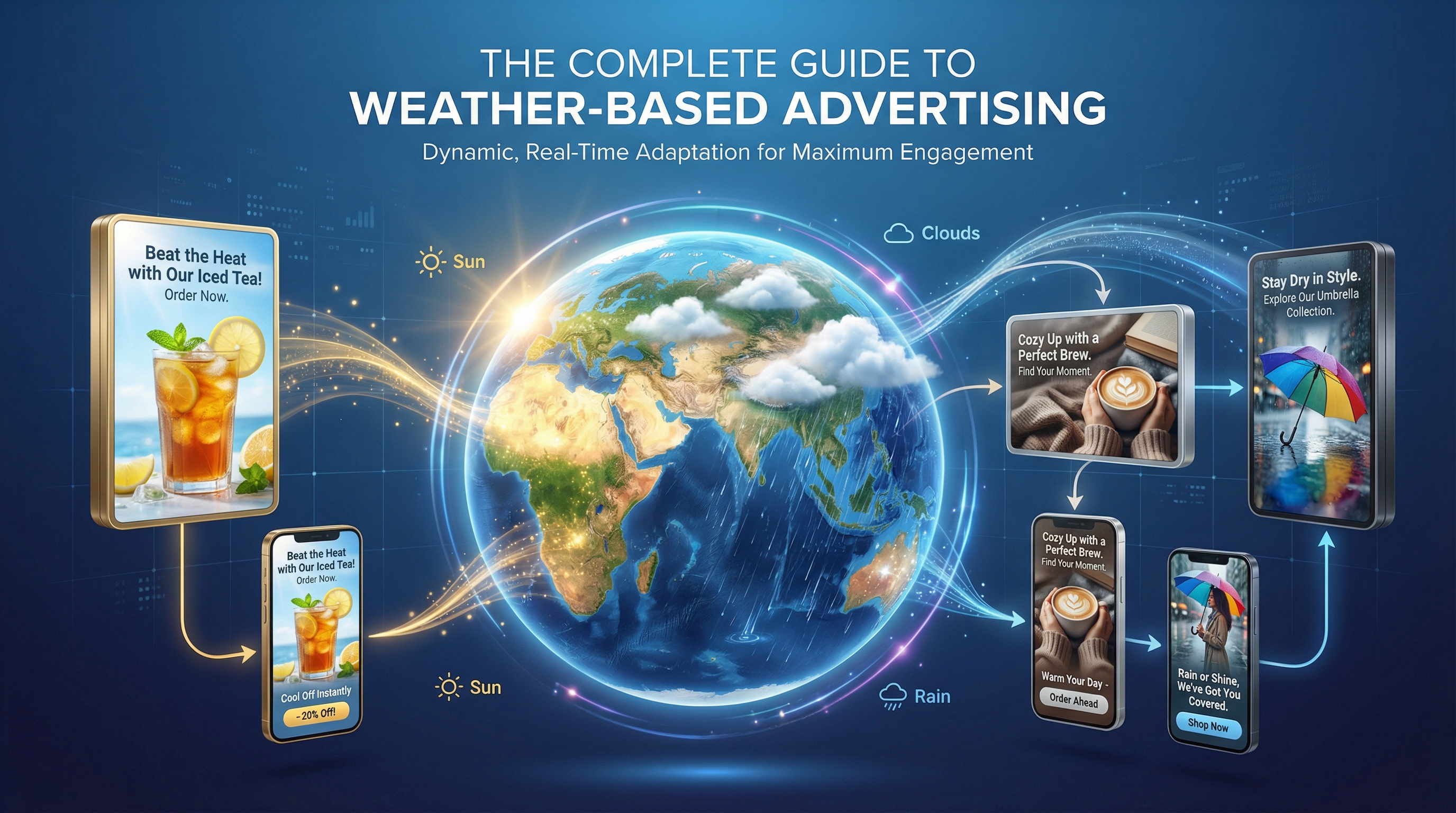
How the $13.5B weather economy is reshaping digital marketing, and how to harness weather data to drive campaign performance across Meta, Google, and beyond.
What Is Weather-Based Advertising?
Weather-based advertising is the practice of delivering targeted ads to audiences based on current, historical, or forecasted weather conditions. It goes far beyond simply running ads when it rains—it’s a sophisticated marketing discipline that combines real-time meteorological data with audience insights, campaign dynamics, and predictive analytics to maximize relevance and ROI.
The concept operates on a fundamental psychological principle: weather directly influences consumer behavior, purchasing decisions, and media consumption habits. A consumer searching for “snow boots” on a snowy morning is primed to convert. A household experiencing a heat wave is more likely to engage with air conditioning ads. A traveler checking weather forecasts is actively planning their trip.
Unlike traditional advertising, which treats all users uniformly, weather-based advertising recognizes that the same person exhibits different needs, priorities, and purchase intent depending on their immediate environmental context.
The Broader Landscape Beyond Triggers
While weather-triggered ads focus on binary conditions (turn campaign on/off when temperature hits X), weather-based advertising encompasses a much wider strategic toolbox:
- Weather-triggered campaigns — Turn campaigns on/off based on real-time conditions
- Weather-responsive creative — Dynamically optimize ad copy, images, and offers based on forecast
- Weather audience targeting — Reach users affected by specific weather conditions
- Weather contextual advertising — Serve ads in weather-related content and apps
- Predictive weather marketing — Use 7-14 day forecasts to plan and optimize spending
This guide covers all five approaches and how they integrate into a cohesive strategy. See our deep dive on what weather-triggered advertising is for the specific mechanics of real-time triggering.
The $13.5B Weather Economy and Why Advertisers Are Paying Attention
The global weather-driven market—including weather data services, SaaS platforms, weather apps, and analytics—is valued at $13.5B and growing 12.5% annually. This isn’t a niche opportunity. It’s a structural shift in how businesses operate and how they reach customers.
Why Weather Matters to Advertisers
1. Weather drives buying behavior. Research from weather intelligence platforms shows that weather conditions directly correlate with purchasing patterns across dozens of categories:
- Umbrellas and rain gear: 200%+ uplift on rainy days
- Heating and cooling: 40-80% increase during extreme temperatures
- Groceries: 25-35% increase in online grocery orders during adverse weather
- Travel and tourism: Bookings surge when weather improves in destination cities
- Quick commerce and food delivery: 50%+ spike during bad weather
See our research on how weather events trigger buying behavior for detailed conversion data by industry.
2. Weather creates urgency. A forecast of snow doesn’t just change what people want to buy—it changes when. Weather events create natural deadline pressure that accelerates purchase timelines and increases conversion rates.
3. Weather improves ad relevance. Ads for snow tires are worthless in July. But in the forecast window before a winter storm, they’re highly relevant. Weather-based targeting eliminates wasteful impressions and improves quality scores across platforms.
4. Weather enables predictive planning. 10-day forecasts allow advertisers to allocate budgets in advance of demand peaks. Instead of reacting to weather, forward-thinking brands predict it and shift spend accordingly.
5. Weather reduces CAC while improving LTV signals. When users are actively searching for solutions to weather-related problems, they’re not just more likely to convert—they’re more likely to be the right customer for your product. Customer quality improves.
The Business Case in Numbers
Companies deploying weather-based advertising report:
- 25-40% improvement in click-through rates vs. non-weather-targeted campaigns
- 15-30% reduction in cost per acquisition through better audience targeting and reduced waste
- 20-50% increase in conversion rates during relevant weather windows
- 3-5x better ROAS on weather-responsive creative vs. static creative
The ROI is driven by one core principle: relevance. Weather provides unprecedented context about what consumers actually need right now.
5 Core Weather-Based Advertising Strategies
Weather-based advertising isn’t a single tactic—it’s a family of complementary strategies that can be deployed independently or in combination. Here are the five core approaches:
1. Weather-Triggered Campaigns (Real-Time Activation)
The most direct application: automatically pause or activate campaigns when weather conditions match your trigger. This is the foundational weather-triggered advertising strategy.
How it works: You define rules (e.g., “activate ice cream campaign when temperature exceeds 85°F”) and automate campaign state changes. When real-time weather data matches your rules, campaigns turn on or off.
Best for:
- Seasonal products with binary triggers (umbrellas, heaters, AC units)
- Location-specific inventory (quick commerce, delivery, retail)
- Services with clear weather dependencies (HVAC, plumbing, moving services)
Implementation complexity: Low to Medium. Requires API access to weather data and campaign management platform. Most platforms (Meta, Google, programmatic) support automation via APIs or native tools. See our guides on triggering Meta ads via Make.com and Google Ads Scripts examples.
Example campaign trigger: A roofing company in the Midwest activates a $5,000/day campaign whenever the forecast predicts thunderstorms within 48 hours. The campaign runs for 36 hours, then pauses. This captures emergency repair demand at the moment homeowners are most worried about storm damage.
2. Weather-Responsive Creative (Dynamic Optimization)
Instead of turning campaigns on/off, dynamically change the creative assets, headlines, and offers based on weather. This maintains consistent ad spend while maximizing relevance.
How it works: You maintain multiple creative variants (e.g., “Sunny day” version, “Rainy day” version, “Cold day” version) and programmatically select which version to serve based on real-time weather at the user’s location. The campaign stays active, but the message changes.
Best for:
- Retail and e-commerce with broad appeal across weather conditions
- Categories where demand doesn’t disappear, but messaging should shift (apparel, food delivery)
- Large advertisers with creative production capacity to build multiple variants
Implementation complexity: Medium to High. Requires dynamic creative optimization (DCO) setup and weather API integration. Most work involves creative production (building variants) rather than technical setup.
Example creative variants: A sportswear brand runs dynamic ads where the primary image and copy shift based on weather:
- Sunny forecast: Hero image of running outdoors, CTA “Get Your Summer Gear”
- Rainy forecast: Hero image of indoor running/gym, CTA “Train Indoors, Stay Dry”
- Cold forecast: Hero image of thermal wear, CTA “Layer Up This Winter”
The same campaign runs continuously, but the message aligns with local weather—improving relevance without stopping spend.
3. Weather Audience Targeting (Behavioral Segmentation)
Rather than triggering campaigns based on weather, use weather data to define and target specific audience segments who are affected by or responsive to weather conditions.
How it works: Weather platforms analyze which users have experienced or will experience specific weather conditions (heat waves, cold spells, rain, snow) and create audience segments. You target these audiences with relevant offers.
Best for:
- Behavioral targeting and predictive audiences
- Building lookalike audiences from weather-affected segments
- Long-tail products that serve weather needs (humidifiers, dehumidifiers, allergy products)
Implementation complexity: Medium. Requires access to weather audience data (from vendor or first-party data enrichment) and audience management tools in your ad platform.
Example audience segment: Create a “heat wave affected users” audience that includes anyone in a ZIP code currently experiencing temperatures above 95°F for 3+ consecutive days. Target these users with ads for electrolyte drinks, cooling towels, and fans. This audience exists for a defined window, then refreshes as the heat wave moves.
4. Weather Contextual Advertising (Content-Based Placement)
Serve ads within weather-related content and apps—weather apps, news articles about weather, meteorology websites, weather-focused social media content. Users actively consuming weather content are in a mindset aligned with weather-dependent products.
How it works: Partner with weather platforms, apps, and publishers; place native or display ads within their weather-related content. These placements are contextually relevant because users are already thinking about weather.
Best for:
- Brands without the technical capability to build complex integrations
- Building brand awareness in high-intent moments (users checking forecasts)
- Direct-to-consumer brands with budget for premium placements
Implementation complexity: Low. Vendor-managed; no technical integration required. Simply manage media spend and creative.
Example placement: An insurance company places native ads within The Weather Channel’s winter storm content: “Does Your Homeowner’s Policy Cover Storm Damage?” Ad appears to users actively reading about storms, driving qualified leads.
5. Predictive Weather Marketing (Forecast-Based Planning)
Use extended forecasts (7-14 day) to anticipate demand and pre-allocate budgets before weather events occur. Rather than reacting to real-time weather, you predict and plan.
How it works: Each day, analyze upcoming forecasts across your target regions. For each forecasted weather event, reserve budget and prepare campaign assets. On the day weather occurs, launch with optimized campaigns.
Best for:
- Brands with predictable, seasonal demand patterns
- Inventory-based businesses (limiting stock availability)
- High-CAC categories where precision matters (luxury, finance)
Implementation complexity: High. Requires sophisticated forecasting models, demand prediction, and budget allocation systems. Most demand-side platforms (DSPs) now offer weather-aware bid optimization that handles this automatically.
Example predictive strategy: A travel company analyzes 10-day forecasts across 50 destinations. When forecasts predict clear weather and comfortable temperatures in Cancun next week (but rain in Miami), the company pre-allocates 60% of weekly budget to Cancun campaigns, knowing demand will surge as travelers change plans.
Combining Strategies for Maximum Impact
The most sophisticated campaigns combine multiple strategies:
- Use predictive marketing to allocate budget 7 days in advance based on forecasts
- Deploy weather triggers when real-time conditions shift dramatically
- Use responsive creative to optimize messaging within active campaigns
- Layer audience targeting to reach weather-affected users more precisely
This layered approach maximizes both efficiency and effectiveness.
Platform-by-Platform Implementation: Where to Deploy Weather-Based Advertising
Weather-based advertising works across every major digital channel. Here’s how to implement it on the platforms where your customers spend time:
Meta (Facebook, Instagram, Messenger)
Best weather strategies: Triggers, responsive creative, audience targeting
Meta offers several levers for weather-based advertising:
- Campaign automation: Use Meta’s Campaign Budget Optimization (CBO) with custom audiences built from weather data. Meta’s AI automatically allocates budget to winning variations—you provide weather-aware audience definitions and creative variants.
- Audience custom data: Upload weather-affected audience segments as custom audiences (e.g., users in heat wave-affected areas). Meta matches these to your customer base.
- API-driven campaign management: Use Meta’s Ads API to programmatically pause/resume campaigns based on weather data. See our guide to triggering Meta ads via Make.com for implementation details.
- Dynamic product ads: For e-commerce, use DPA with weather-segmented audiences to automatically show relevant products.
Implementation timeline: 2-4 weeks to set up audience data pipelines and campaign structure.
Google Ads & Google Shopping
Best weather strategies: Triggers, bid adjustments, responsive search ads
Google offers powerful, native weather integration:
- Smart Bidding with weather triggers: Use Target ROAS or Target CPA bidding with weather-aware conversion data. Google’s ML learns which weather conditions drive conversions and adjusts bids automatically.
- Responsive Search Ads (RSAs): Create multiple headlines and descriptions, then let Google’s algorithm select the best combinations based on user context—including weather signals Google has about that user’s location.
- Google Ads Scripts: Write custom scripts to trigger campaigns on weather conditions. See our Google Ads Scripts example for code.
- Keyword-level bid adjustments: Increase bids for weather-dependent keywords when conditions are favorable (e.g., +25% bid boost on “emergency plumber” during thunderstorms).
- Location-based bid adjustments: Adjust bids by location based on local weather forecast.
Key advantage: Google already has weather data and device location data. You’re leveraging what Google knows about users’ environments.
Implementation timeline: 1-2 weeks for Scripts-based triggers; ongoing for Smart Bidding optimization.
Programmatic & Real-Time Bidding (RTB)
Best weather strategies: Audience targeting, bid optimization, predictive planning
Programmatic platforms enable sophisticated weather integration:
- First-party weather data: Integrate real-time weather APIs into your DSP’s audience segmentation. Create segments like “users in areas with rain forecast” and bid up for those impressions.
- Weather data enrichment: Many demand-side platforms (The Trade Desk, DV360, Programmatic.com) now offer native weather data enrichment. Enable it and let your ML bid optimizer factor weather into decisions.
- Custom algorithms: Build or upload proprietary weather conversion models. DSPs like The Trade Desk allow custom ML models that factor in weather and other contextual signals.
- Cross-channel coordination: Programmatic buying covers display, video, and native—coordinate weather strategy across all three.
Implementation complexity: Medium to High. Requires data engineering to connect weather APIs, but most modern DSPs have native weather support.
Email Marketing
Best weather strategies: Responsive content, predictive send times, dynamic subject lines
Weather-based email is underutilized but highly effective:
- Dynamic email content: Platforms like Klaviyo, HubSpot, and Iterable support dynamic blocks that change based on recipient location and weather. Show winter coats in cold forecasts, sandals in hot forecasts.
- Predictive send times: Send emails just before weather-triggered demand peaks. Forecast rain for tomorrow? Send umbrella email tonight.
- Weather-triggered automation: Set up email sequences triggered by weather events (heat wave forecasted → send sunscreen campaign).
- A/B testing weather variants: Test weather-responsive subject lines (“Don’t Get Caught in the Rain” vs. “Stay Dry This Weekend”) against static controls.
Example flow: A clothing brand integrates weather API into Klaviyo. Each night, the system analyzes tomorrow’s forecast for each subscriber’s location and dynamically populates an email template with weather-appropriate products and messaging. Send time is optimized for engagement patterns + weather timing.
Implementation timeline: 1-2 weeks; most modern email platforms have native dynamic block support.
Digital Out-of-Home (DOOH) & Static OOH
Best weather strategies: Responsive creative, contextual messaging, real-time optimization
Weather-based DOOH is one of the fastest-growing channels:
- Dynamic creative rotation: DOOH networks like Outfront and Clear Channel allow real-time creative swaps based on weather. Show sunscreen ads during sunny stretches, umbrella ads during rain.
- Real-time bidding: Some DOOH exchanges support programmatic buying with weather-based targeting. Bid up when weather conditions match your target audience.
- Static placement strategy: For traditional billboards, place weather-dependent ads in locations where you know weather dynamics. Put umbrella ads on commute routes in rainy climates; put sunscreen ads near beaches in sunny destinations.
Example deployment: A quick-commerce brand deploys dynamic DOOH in 20 cities. Real-time weather feeds trigger different creative every hour: rainy forecast → “Groceries Delivered in 15 Minutes,” sunny forecast → “Summer Essentials Ready for You.” Campaign automatically optimizes for real-time weather without manual intervention.
Retail & Mobile Commerce
Best weather strategies: In-store promotions, mobile push notifications, location-based offers
- Push notification timing: Send location-based push offers just before relevant shopping moments (umbrella push on rainy morning commute).
- In-store dynamic displays: Integrate weather data with in-store signage to match promotions to conditions.
- Location-based mobile ads: Geofence retail locations and adjust offers based on weather (higher discount during bad weather to drive traffic).
Building Your Weather-Based Advertising Strategy from Scratch
Ready to implement weather-based advertising? Here’s a step-by-step framework:
Step 1: Identify Weather-Dependent Product Categories
Not everything sells better in certain weather—but most things do. Audit your product portfolio:
- Direct weather dependency: Does demand directly correlate with weather? (rain → umbrellas, heat → AC). Rate: HIGH priority.
- Indirect weather correlation: Does weather influence behavior without being the primary driver? (cold weather → hot coffee, sunny days → outdoor events). Rate: MEDIUM priority.
- No weather correlation: Would weather-based advertising waste money? (medications with stable demand). Rate: LOW priority.
Build a weather sensitivity matrix for your catalog. Start with HIGH and MEDIUM priority products.
Step 2: Define Weather Triggers and Thresholds
For each product category, define the weather conditions that drive demand:
- Temperature thresholds: At what temperature does demand surge? (85°F for AC, below 45°F for heaters)
- Precipitation rules: Does rain, snow, or sleet trigger demand? How much accumulation matters?
- Other conditions: Wind, humidity, UV index, pollen counts, air quality—which matter for your category?
- Geographic specificity: Which regions/cities matter? (Sunscreen in Phoenix more than Seattle)
- Lead time: Does demand spike immediately (umbrellas) or 24-48 hours before (travel bookings)?
Document trigger rules like: “Activate Home Heating campaign when forecast predicts temperature below 35°F for 3+ days in residential ZIP codes in Northern states.”
Step 3: Analyze Historical Conversion Data by Weather
Look backward before looking forward:
- Pull 12-24 months of conversion data (transactions, leads, clicks)
- Cross-reference with historical weather data for user locations
- Identify patterns: Which weather conditions drove highest conversion rates? AOV? ROI?
- Segment by geography, season, product category
This analysis quantifies the opportunity and informs your trigger thresholds. “We get 3x conversion rate when it’s raining” is more credible than assumptions.
Step 4: Choose Your Technology Stack
You’ll need three components:
- Weather data source: API that delivers current and forecast data. See section below on weather data sources.
- Campaign orchestration layer: Automation platform that ingests weather data and triggers campaign changes. Options: Make.com, Zapier, custom webhooks, native ad platform APIs.
- Ad platform integration: Native support in Meta, Google, DSP, or email provider.
Most setups involve: Weather API → Orchestration Platform → Ad Platform APIs → Campaign state changes.
Step 5: Design Your First Campaign
Start small. Pick one high-confidence product category and one geography:
- Product: “Emergency plumbing services”
- Geography: “Chicago, IL”
- Trigger: “Freeze warning or temperature forecast below 20°F for next 24 hours”
- Action: “Increase daily budget from $500 to $2,000 and activate ‘burst’ creative variant”
- Duration: “Maintain elevated budget for 48 hours after weather event”
Run this for 4-8 weeks. Measure impact vs. non-weather-targeted baseline. If successful, expand to other geographies and product categories.
Step 6: Monitor, Measure, and Iterate
Set up tracking for:
- CTR, CPC, conversion rate, CPA during weather events vs. normal periods
- ROI by campaign (weather-triggered vs. always-on baseline)
- Weather condition accuracy (are triggers firing at the right times?)
- Attribution (credit weight to weather-driven conversions)
Monthly reviews: Refine thresholds, adjust creative messaging, expand to new products/geographies based on results.
Weather Data Sources and Technology Stack
The quality and reliability of your weather data directly impacts campaign performance. Here are the leading sources and platforms:
Weather APIs & Data Providers
- OpenWeather (openweathermap.org): Most popular free and paid tier. Covers current, forecast, and historical data. Reliable for 99% of use cases. Integration: API calls to get weather by latitude/longitude or ZIP code.
- Weather.com (The Weather Company, IBM): Premium provider, high accuracy. Used by most enterprise weather platforms. Integrates via data partnerships; less common as direct API.
- NOAA (National Oceanic and Atmospheric Administration): US government weather data. Free, highly accurate, but less polished API. Good for US-focused campaigns.
- Weatherstack: Global weather API with 200+ data fields. Good for international campaigns. Freemium model.
- WeatherAPI: Developer-friendly, affordable, global coverage. Growing adoption in MarTech.
- Dark Sky (now Apple WeatherKit): Hyper-local forecasting, formerly the gold standard. Now integrated into Apple ecosystem; limited third-party API access.
Orchestration & Automation Platforms
These platforms connect weather data to your ad campaigns:
- Make.com (formerly Integromat): Visual automation builder. Connect OpenWeather → Meta Ads or Google Ads APIs. No code required. Used in triggering Meta ads via Make.com.
- Zapier: Similar to Make; lower complexity, fewer advanced features.
- Native ad platform automation: Google Ads Scripts, Meta Ads Manager scheduling, native DSP features. No third-party tool needed.
- Custom webhooks/serverless functions: AWS Lambda, Google Cloud Functions, Azure Functions. For teams with engineering resources; maximum flexibility.
- WeatherTrigger: Specialized platform built specifically for weather-based campaign automation across Meta, Google, and programmatic. Handles all plumbing; you define triggers.
Recommended Tech Stack by Use Case
Small business (1-5 ad accounts, limited budget):
- Weather source: OpenWeather free tier
- Orchestration: Make.com with free plan
- Ad platform: Native Google Ads Scripts or Meta API
Mid-market (5-20 accounts, growing sophistication):
- Weather source: OpenWeather paid or Weatherstack
- Orchestration: Make.com pro or custom serverless function
- Ad platform: Meta API + Google API + DSP integrations
- Consider: WeatherTrigger platform for unified management
Enterprise (20+ accounts, multiple geographies, complex logic):
- Weather source: Direct partnership with The Weather Company or NOAA
- Orchestration: Custom ML pipeline with internal data warehouse
- Ad platform: Native integrations across 5+ channels
- Add: Demand forecasting engine for predictive planning
Data Accuracy and Coverage
Weather data quality varies by provider and geography:
- Forecast accuracy: 1-day forecasts are 85-95% accurate; 7-day forecasts drop to 60-80% accuracy
- Real-time data: Based on ground stations, radar, and satellites. More accurate in urban areas, less reliable in remote regions
- Hyper-local coverage: Weather varies dramatically by location. Use latitude/longitude or precise ZIP codes, not just city names
- Data latency: Most free/low-cost APIs update hourly. Premium providers offer 15-30 minute refresh rates
For critical campaigns (high-volume seasonal products), invest in premium weather data with higher accuracy and faster refresh rates.
ROI and Performance Benchmarks: What to Expect
Here’s what companies deploying weather-based advertising see, based on industry reports and our customer data:
Conversion Rate Improvements
| Weather-Dependent Category | Typical Conversion Lift | Peak Season Variance |
|---|---|---|
| HVAC (heating/cooling) | +35-50% | 200-400% during extreme temps |
| Rain/snow gear (umbrellas, boots, winter apparel) | +45-60% | 300-500% during weather events |
| Quick commerce/grocery delivery | +20-35% | 150-250% during adverse weather |
| Travel & tourism | +25-40% | Varies by destination forecast |
| Food & beverage | +15-30% | 100-200% during seasonal peaks |
| Outdoor recreation | +20-40% | 250-400% during ideal conditions |
Cost Per Acquisition (CPA) Reduction
Weather-based targeting reduces wasted spend:
- Historical average CPA reduction: 15-30%
- Why: You’re not showing winter coat ads in summer; not showing ice melt ads to southern Arizona
- Strongest reductions in categories with strong seasonal dependency
Return on Ad Spend (ROAS)
- Typical improvement: 3-5x for weather-responsive creative vs. static creative during relevant weather windows
- Example: Static umbrella ad ROAS = 2.5x. Weather-triggered umbrella ad during rain forecast = 8-12x ROAS
- Improvement is highest for inventory-constrained categories (limited supply)
Click-Through Rate (CTR) Improvements
- Typical CTR lift: 25-40% for weather-relevant ads vs. non-weather-targeted baseline
- Driven by higher relevance and better message-audience fit
- Responsive creative (messaging changes with weather) typically outperforms binary on/off triggers
Budget Efficiency
- Companies using weather-triggered campaigns often reduce total ad spend by 10-20% while maintaining or increasing revenue
- Freed budget can be reallocated to year-round campaigns or other high-ROI channels
Payback Period
Weather-based advertising setup typically pays back in 4-8 weeks through improved efficiency:
- Setup cost: $5,000-$25,000 (depending on platform and complexity)
- Monthly recurring: $500-$5,000 (tools, APIs, labor)
- Monthly efficiency gain: $10,000-$50,000 (reduced CPA × volume)
- Payback: 4-8 weeks for most mid-market businesses
Benchmarks by Platform
Meta (Facebook, Instagram): 20-35% CTR improvement, 15-25% CPA reduction. Best for consumer-focused categories.
Google (Search, Shopping, Display): 25-40% conversion rate improvement, 20-30% CPA reduction. Search captures highest-intent queries during weather events.
Email: 30-50% open rate improvement for weather-triggered sends, 25-40% CTR improvement. Best ROI channel; low incrementality risk.
Programmatic: 10-20% CTR improvement, 15-25% CPA reduction. More modest than direct platforms due to brand safety and context loss in RTB.
Important Caveat: Attribution and Incrementality
Weather improvements are real, but careful with attribution claims:
- Some lift comes from natural demand seasonality (people buying umbrellas because it’s fall, not just because it rained today)
- Run proper experiments: test campaigns against geographically different control groups to isolate weather impact
- Use incrementality testing (holdout groups) to measure true causal impact
Conservative assumption: 60-70% of reported lift is incremental; 30-40% is pre-existing seasonality.
Industry-Specific Weather-Based Advertising Playbooks
Weather impact varies dramatically by industry. Here are proven playbooks for major verticals:
HVAC & Home Services
Weather triggers: Temperature extremes (above 90°F or below 30°F), freeze warnings
Strategy:
- Predictive planning: 7-10 days before forecasted extreme temps, increase budget 50%
- Real-time triggers: Freeze warnings or dangerous heat alerts activate emergency response campaigns
- Responsive creative: “Broken heating in winter” vs. “AC repair during heat wave”
- Audience: Target homeowners in affected ZIP codes
Expected ROI: 3-5x during relevant seasons; negative ROI in off-seasons
Retail & Apparel
Weather triggers: Seasonal shifts, temperature changes, precipitation forecasts
Strategy:
- Responsive creative: Winter coat campaign shifts to “spring layers” when temps forecast to rise
- Inventory-driven: Boost budget for overstocked seasonal items when weather turns favorable for that item
- Location-based: Show heavy coats to northern regions during cold, show light jackets to southern regions transitioning from winter
- Dynamic collections: Feature weather-appropriate products in homepage recommendations
Relevant existing post: Seasonal Shopify catalogs
Expected ROI: 1.5-2.5x; strong in peak seasons, neutral in shoulders
Quick Commerce & Food Delivery
Weather triggers: Rain, snow, extreme heat, cold
Strategy:
- Real-time triggers: Bad weather forecast → increase bids 30-50% for next 6 hours
- Responsive creative: “Delivery in 15 mins” during rain; “Fresh groceries” during normal weather
- Predictive surge pricing: Pre-allocate budget before rain hits; surge pricing during rain
- Push notifications: Send offers to app users 30 minutes before forecasted rain (highest conversion moment)
Expected ROI: 2-4x during adverse weather; 0.8-1.2x during clear weather
Travel & Tourism
Weather triggers: Destination weather forecasts, origin weather (weekend escapes during rain)
Strategy:
- Predictive planning: 10-14 days before forecasted clear weather in popular destinations, increase destination-specific campaigns
- Reactive optimization: When origin weather forecast turns bad, increase travel ads (people want to escape)
- Responsive offers: “Beach escape” when sunny forecast; “ski deals” when snow forecast
- Audience: Target weekend planners with weather alerts in their local area
Relevant existing post: Travel and tourism weather-based ads
Expected ROI: 2-3.5x during shoulder seasons; higher in off-season
Insurance
Weather triggers: Freeze warnings, thunderstorm watches, hurricane warnings, extreme heat
Strategy:
- News hijacking: When major storm warning issued, activate damage/liability insurance campaigns within hours
- Preventive messaging: 24-48 hours before forecasted weather, run “protect your home” campaigns
- Audience: Target homeowners in warning zones with property-specific messaging
Expected ROI: 2-4x during warning windows; strong brand lift
Outdoor Recreation & Sports
Weather triggers: Ideal conditions for activity (snow for ski resorts, sun for beach, rain for kayaking)
Strategy:
- Predictive messaging: “Fresh powder alert” when snow forecast; “waves incoming” when storm forecast for coastal areas
- Booking windows: Increase budget 48 hours before ideal conditions
- Responsive creative: “Sunny beach days” vs. “cozy indoor activities” based on forecast
Expected ROI: 2-5x during activity-ideal weather; strong seasonal variance
Agriculture & Landscaping Services
Weather triggers: Frost dates, growing season start, drought conditions, excessive moisture
Strategy:
- B2B targeting: Ads to farmers/landscapers just before they need services (pre-spring, pre-dormancy)
- Supply vendors: Boost ads for fertilizer/seed when planting window opens
- Service triggers: Irrigation service ads when drought forecast; drainage service ads when heavy rain forecast
Expected ROI: 2-3x during relevant windows; highly seasonal
Cross-Industry Insights
- Strongest ROI improvements: HVAC, quick commerce, outdoor recreation (2-5x range)
- Most consistent improvements: Travel, retail, insurance (predictable seasonality)
- Most complex to optimize: Food/beverage, apparel (weather is one factor among many)
- Best for new advertisers: Quick commerce, HVAC (simple triggers, fast feedback loop)
The Future: AI, Climate Change, Cookieless Targeting, and Privacy
Weather-based advertising is evolving faster than most marketing channels. Here’s what’s coming:
AI-Powered Weather Forecasting and Demand Prediction
AI weather models (like DeepMind’s GraphCast) are improving forecast accuracy and expanding lead time beyond current 10-14 day limits. Implications:
- 30-day planning: Within 2-3 years, weather-triggered campaigns will shift from 7-14 day forecasts to 30-day predictive planning
- Demand forecasting integration: AI will connect weather forecasts directly to demand predictions (“this weather pattern drives X% increase in demand for product Y 3 weeks out”)
- Autonomous campaign optimization: ML will optimize campaign parameters (budget, creative, audience) without human intervention
Climate Change and Long-Tail Weather Events
Extreme weather is becoming more common. Implications for advertising:
- Year-round demand for seasonal products: As traditional seasons blur, products that were “seasonal” will have longer selling windows
- New products and verticals: Climate adaptation (cooling tech, drought-resistant seeds, flood insurance) will become major ad categories
- Regulatory changes: How to advertise climate-sensitive products will face more scrutiny; transparency in weather data use will matter
- Risk management: Insurers and marketers will shift toward weather-resilience advertising, not just opportunistic marketing
See our deep dive on climate change and advertising.
Cookieless Targeting and First-Party Weather Data
As third-party cookies disappear, weather becomes a more valuable first-party targeting signal:
- First-party weather data: Brands will collect their own weather data (user location + weather conditions at purchase time) to build proprietary models
- Cohort-based targeting: Instead of targeting individuals by weather, target cohorts of users who experienced similar conditions
- Contextual advertising resurgence: Weather context (what app/site user is on) becomes more valuable as behavioral targeting dims
Privacy and Data Ethics
Weather-based targeting raises privacy questions:
- Location data sensitivity: Using precise location + weather to target users raises privacy concerns (especially for sensitive categories)
- Regulation: Expect regulatory guidance on weather data use similar to GDPR for personal data
- Transparency: Brands that disclose their weather-based targeting will gain trust; those hiding it will face backlash
- Consent requirements: Likely future: explicit user consent before using weather + location for targeting
Integration with Broader Contextual Signals
Weather won’t remain isolated; it’s becoming part of richer context layers:
- Context layers: Weather + time of day + device type + content being consumed → much richer signals
- Social signals: Weather trending on social + weather events + news = more sophisticated audience understanding
- Real-time bidding evolution: Weather will be native signal in DSPs alongside audience, content, time, device
Industry Consolidation
Weather-based advertising tools are fragmenting; consolidation will follow:
- Expect: Major ad platforms (Google, Meta) will bake weather-native features into core products
- Expect: Specialized weather-as-a-service platforms will either consolidate or get acquired
- Expect: Marketing clouds (HubSpot, Salesforce) will integrate weather APIs as standard features
What Brands Should Do Now
- Start small: Implement basic weather triggers for 1-2 high-dependency product categories
- Build first-party data: Start collecting and analyzing your own weather + conversion data
- Test creative variants: Invest in weather-responsive creative (you’ll need multiple variants for future multi-channel campaigns)
- Plan for privacy: Build consent and transparency into your weather data strategy from day one
Frequently Asked Questions: Weather-Based Advertising
Q: What’s the difference between weather-triggered ads and weather-based advertising?
A: Weather-triggered ads are a specific tactic (turn campaigns on/off based on real-time weather). Weather-based advertising is the broader discipline, which includes triggers, responsive creative, audience targeting, contextual placements, and predictive planning. Think of weather triggers as one tool in a larger toolkit. See our full explainer on what weather-triggered advertising is vs. the broader strategy in this guide.
Q: Which industries benefit most from weather-based advertising?
A: HVAC, quick commerce, travel, insurance, and outdoor recreation see the largest ROI improvements (2-5x). Retail, food/beverage, and agriculture see more modest but still significant improvements (1.5-3x). Industries with low weather dependency (healthcare, SaaS, luxury goods) see minimal benefit. Audit your own product-weather correlation to prioritize.
Q: Do I need expensive weather data APIs, or will free options work?
A: Start with free or low-cost APIs (OpenWeather, WeatherAPI). They’re reliable for 90%+ of use cases. Upgrade to premium data (The Weather Company, NOAA premium) only if you’re running high-volume campaigns where 5% better forecast accuracy translates to significant ROI gains. Most small-to-mid-market businesses succeed with free APIs.
Q: How long does it take to implement weather-based advertising?
A: Depends on complexity. Simple trigger campaigns: 2-4 weeks (weather API integration + campaign setup). Responsive creative: 4-8 weeks (creative production is the bottleneck, not tech). Enterprise-scale predictive planning: 3-6 months (building forecasting models). Most businesses see results within 4-8 weeks of launch.
Q: Is weather-based advertising susceptible to fraud or manipulation?
A: Minimal fraud risk because weather data is public and verified by multiple sources. However, weather data API reliability varies—choose providers with high uptime SLAs (99.9%+). Also, ensure your automation logic has safeguards: don’t let budget caps get blown out by unexpected trigger events. Test thoroughly before going live with high-budget campaigns.
Q: What if we operate across multiple geographies with different weather patterns?
A: This is actually where weather-based advertising shines. Use location-level weather data (not city-wide aggregates) and segment your campaigns by geography. Different regions can have different trigger thresholds and budget allocations based on their climate. This hyper-local approach is one of the biggest ROI levers for national brands.
Q: How do I measure the actual impact of weather-based advertising vs. natural seasonality?
A: Run proper A/B tests: test campaigns against geographically-different control groups, or use incrementality testing (holdout groups). Compare weather-triggered campaign performance to baseline campaigns in the same period. Be honest: 30-40% of lift is typically natural seasonality, not incremental weather impact.
Q: Can I use weather-based advertising on all platforms, or just Google and Meta?
A: You can use it on all major platforms: Google, Meta, email, programmatic, DOOH, retail. Implementation varies (some platforms have native weather support, others require external APIs), but the strategic principle works everywhere. Email and programmatic are actually underutilized channels for weather-based campaigns.
Getting Started with Weather-Based Advertising Today
Ready to implement weather-based advertising? Here’s your action plan:
Week 1: Assessment
- Audit your product catalog for weather sensitivity (HIGH/MEDIUM/LOW)
- Pull 6-12 months of conversion data by location and weather
- Identify your first pilot campaign (1 product, 1-3 geographies, clear trigger)
Week 2-3: Technical Setup
- Choose your weather data API (OpenWeather recommended for most)
- Choose your orchestration platform (Make.com for non-technical teams, custom function for advanced)
- Set up initial campaign automation for pilot
Week 4: Launch
- Go live with pilot campaign
- Monitor daily for first 2 weeks; fix any issues
- Start collecting performance data against baseline
Week 5-8: Optimization
- Analyze results vs. non-weather-triggered baseline
- Refine trigger thresholds based on performance
- If successful, expand to additional products/geographies
Next Steps
If you’re looking for a platform that handles all the complexity—connecting weather APIs, managing campaign logic across Meta and Google, tracking performance—consider WeatherTrigger. We automate the entire weather-to-campaign pipeline so you focus on strategy, not infrastructure.
Make Weather Your Competitive Advantage
Weather-based advertising is no longer a niche tactic—it’s a core discipline for brands that want to compete on relevance and ROI. The brands implementing weather-based strategies today are already 2-5x more efficient than competitors who ignore it.
Don’t leave revenue on the table. Start with a single high-ROI product category, measure incrementally, and scale what works.
Explore WeatherTrigger Platform
Free tier available. No credit card required.