How Climate Change Is Quietly Changing Advertising
Advertising has always been about reading the room: what people want, when they want it, and how they want to hear about it. The room is changing. More frequent heatwaves, bushfires, floods and unseasonal weather are changing when people shop, what they buy and how they react to marketing.
The change is gradual, which is why it’s easy to miss. Seasonal plans built on what summer or winter “usually” looks like are becoming less reliable, and the evidence on consumer spending shows it.
The New Reality: When Weather Becomes Strategy
Traditional advertising runs on predictable seasons. Summer means cold drinks and beach holidays. Winter means jackets and hot chocolate. Those assumptions still hold on average, but individual weeks can depart sharply from them, and spending follows the weather.
The data is already showing up in Australia and overseas:
- A warm winter lifted Australian retail. The ABS said retail turnover rose 0.7% in August 2024 and put it down to the warmest August on record since 1910. Clothing rose 1.5% and department stores 1.6%.
- Extreme heat changes when Australians spend. A study of about 200 million Westpac card transactions in Sydney, Melbourne and Adelaide found that on days of 35°C or more, daytime spending fell by about $5.4 million a day. Spending between noon and 6 pm dropped 12-13%, evening spending rose about 5%, and spending was 2.4% higher in the week after the heat.
- Heatwaves push shopping online. During the UK’s June 2026 heatwave, online non-food sales rose 5.1% year on year while in-store non-food sales fell 1.1%, according to BRC-KPMG data.
The most important finding for climate planning comes from economist Brigitte Roth Tran. Studying daily store sales for a US apparel and sporting goods brand, she found that shoppers adapt to rain, snow and cold, but not to extreme heat. People in cold places learn to shop in the cold. Nobody seems to get used to shopping in a heatwave. As hot days become more common, their effect on sales won’t fade on its own.
This is about more than pulling ads during a disaster. Annual plans with quarterly reviews can’t respond to a heatwave that arrives in three days. Advertisers need a way to react to the weather within hours, and a set of ads ready for the conditions they’re likely to face.
The Psychological Shift: The Climate-Conscious Consumer
Climate change also affects how people read advertising.
Many consumers, especially younger ones, now question corporate environmental claims. “Greenwashing” has become an everyday word, and brands that overstate their credentials risk a public backlash.
Lived experience matters too. Someone who has been through a flood reads insurance advertising differently. A parent who kept children inside during bushfire smoke reacts differently to health and air-quality messages. Psychologists call this the availability heuristic: people judge how likely something is by how easily they can recall an example. For advertisers, messages about preparation and resilience are more likely to land, and messages that ignore conditions outside are more likely to jar.
The Rise of Responsive Advertising
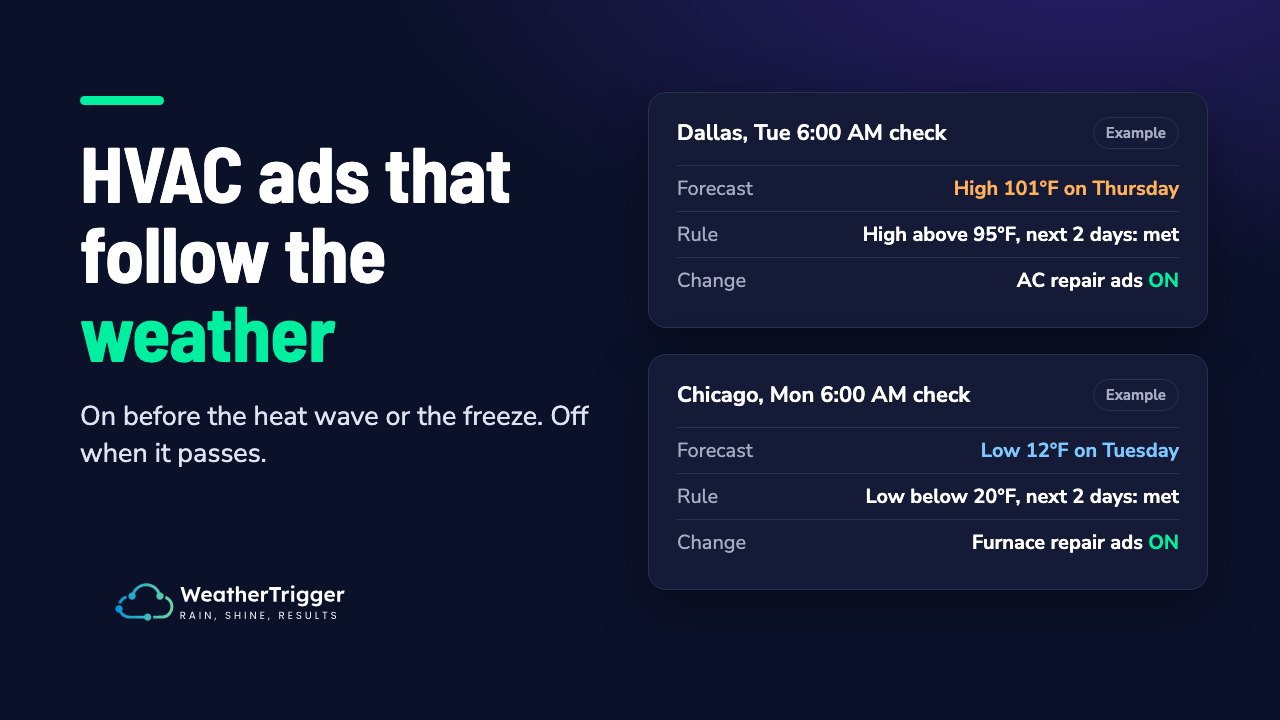
Responding to the weather in real time is now practical, but it isn’t built into the major ad platforms. Neither Meta nor Google Ads offers native weather targeting, and Meta’s automated rules can’t read weather conditions. Weather-responsive campaigns rely on a separate tool, script or automation that checks a weather feed and switches ads on or off through the platform’s API.
Well-known examples exist outside social media. Guinness Australia’s 2023 “Brewery of Meteorology” campaign switched on digital billboards within a kilometre of pubs when the temperature fell below 7°C, and won a JCDecaux programmatic award with pub visits up 14.7%.
Technology alone isn’t enough. It decides when an ad runs. People still have to decide what it says and when it’s better to say nothing. For example, during a smoke haze event an outdoor fitness brand could pause its outdoor ads and switch to ads for indoor classes. The rule does the switching. The judgement about tone comes from a person.
Product Positioning in a Climate-Altered World
Climate change affects which products need advertising and how they’re framed. Cooling products, water storage, storm preparation and home insurance all become more relevant as extreme weather becomes more common. Some products that were once sold as treats, such as ice cream or a cold drink on a hot afternoon, are also about relief from the heat.
The practical point for advertisers: the same product may need different messages for different conditions. A message about comfort suits a mild day. A message about relief or safety suits a heatwave.
The Authenticity Imperative
Consumers who have lived through climate impacts are quick to spot hypocrisy. Brands that make environmental claims need to be able to back them up.
The best-known example of a brand putting its own product under scrutiny is still Patagonia’s “Don’t Buy This Jacket” advertisement, which ran in The New York Times on Black Friday in 2011. It asked readers to think about the environmental cost of what they bought, including Patagonia’s own jacket. It worked because the company’s behaviour matched the message.
The same applies when disaster strikes. A logo change or a sympathetic post means little without action behind it, such as support for affected staff, customers and communities.
Regional Complexity
Climate change doesn’t affect every region the same way. A campaign built around outdoor summer fun might suit Hobart in January and feel out of touch in Adelaide during a week of 42°C days. Western Sydney and the eastern beaches can be several degrees apart on the same afternoon.
That argues for local decisions over national ones. A national on/off switch treats every location as if it had the same weather. Rules set per city or region let ads follow the conditions where people actually are.
Crisis Communication
With more frequent disasters, every brand needs a plan for what its advertising does when one hits.
At the least, that means knowing which campaigns to pause when a severe weather warning is issued, so a cheerful promotion doesn’t run into a community dealing with a flood or fire. Beyond that, brands with something useful to offer, such as emergency supplies, temporary accommodation or practical advice, can share it in a way that helps rather than exploits the moment.
The Data Behind the Decisions
Weather data is becoming as useful to advertisers as demographic data, mainly because weather effects are so local. Planalytics, which models weather-driven demand, found weather lifted US air conditioner demand by 4% nationally in one month but 31% in a single city. National averages hide most of the signal.
Measurement needs the same care. Sales rise in hot weather whether or not you advertise, so compare locations where a weather rule ran against similar locations where it didn’t. Our weather ad measurement guide walks through how.
Sustainability as a Creative Driver
Climate change is a constraint, but it can also be a source of useful, honest creative. Campaigns that help people cope with real conditions tend to earn more trust than campaigns that ignore them.
An insurer might share practical tips for preparing a home before storm season. A clothing brand might explain how a fabric keeps you cool. That kind of content gives people something useful, and it only works if the brand’s own behaviour backs it up.
The Economic Imperative
Weather volatility makes budgets harder to plan. A heatwave can bring demand forward, a wet month can push it back, and a supply disruption can leave you advertising a product you can’t deliver. Rigid monthly budgets set months ahead struggle with that.
A more flexible approach keeps a base level of always-on advertising and adds weather-triggered activity when conditions favour your product. It also pauses ads when they’re unlikely to convert or when stock is short.
Looking Ahead
The most likely near-term change is simple: more advertisers will tie campaigns to local weather conditions instead of calendar dates. The tools to do that already exist. What’s changing is how often the weather departs from the plan.
Two things are worth doing now:
- Identify the weather that moves your sales. Look back at your own data for hot spells, wet weekends and storms, and see what happened.
- Prepare ads for those conditions in advance. A heatwave ad written in the middle of a heatwave is usually too late.
Conclusion
Climate change is reshaping advertising gradually rather than dramatically. Seasons are less predictable, heat changes when people shop, and consumers are more alert to how brands talk about the environment.
The brands that handle this well will plan for weather rather than assuming it, react quickly when conditions change, and back up what they say with what they do.
WeatherTrigger pauses and resumes Meta ad sets based on the weather in each location, including heat, rain, wind and severe weather alerts, and logs every check. Google Ads support is coming soon. Try it free for 30 days, no card needed.