How Weather Affects Social Media Usage: And How Marketers Can Leverage It

When you think about what shapes the mood of people scrolling social media, weather might not be the first thing that comes to mind. But researchers working with billions of posts have found that the sky outside has a measurable effect on what people share.
For marketers, that matters. The same audience sees your ad on a grey, wet afternoon and on a bright, mild one, and they are not in the same frame of mind.
In this article, we’ll cover:
- What the research says about weather and social media
- Why bad weather matters for brands in the feed
- How to handle extreme weather events
- Practical ways to use weather in your social media and ads
- A real example of weather-triggered marketing
What the research actually shows
The connection between weather and mood has been studied for decades. Large social media datasets have let researchers measure it at a scale that wasn’t possible before. Two studies stand out.
Weather shifts the sentiment of posts. Baylis, Obradovich and colleagues (PLOS ONE, 2018) analysed about 3.5 billion Facebook and Twitter posts from 75 US metro areas between 2009 and 2016. They measured the tone of what people wrote, not how much time they spent online. Positive sentiment peaked at around 20°C and fell away above 30°C. Rain, humidity above 80% and heavy cloud all made posts more negative. Below-freezing days had an effect about 62% the size of a major flood.
Rain’s effect spreads through friend networks. Coviello and colleagues (PLOS ONE, 2014), a study co-authored by Facebook data scientists, found that an average rainy day reduced positive Facebook posts by 1.19% and increased negative posts by 1.16%. The effect didn’t stop there. People whose friends were posting from rainy cities also became more negative, even when it wasn’t raining where they were. The researchers estimated that the total effect of rain was about 150% larger than the direct effect alone.
Neither study measured how much time people spend on social media in bad weather. It’s plausible that people who stay indoors scroll more, but we haven’t found solid public data that puts a number on it.
Why this matters for brands
If your audience’s feed is full of people complaining about the weather, the mood you’re advertising into has changed. That gives you two choices:
- Match the mood. Comfort, warmth, convenience and staying in suit a wet, cold day.
- Break the mood. Upbeat content can stand out when the rest of the feed is gloomy.
Which one works better depends on your product and your audience. The only reliable way to know is to test it.
Extreme weather events
During storms, floods, bushfires and heatwaves, people turn to social media for updates, safety information and to check on each other. This is not the time for most promotions.
- Where you can help, do: a hardware store sharing storm preparation tips or an insurer explaining how to lodge a claim is useful.
- Where you can’t, step back: an unrelated promotion during a natural disaster looks opportunistic and can do lasting damage to your brand.
It’s also worth checking which of your ads are scheduled to run in affected areas and pausing them if the tone is wrong.
5 ways to use weather in your social media strategy
1. Plan posts around the forecast
Strategy: Check the forecast for your key markets. If a wet weekend, a cold snap or a heatwave is coming, plan content for it in advance.
Example: A streaming service might promote a new series ahead of a rainy weekend with a post like:
“Looks like a stay-in weekend, Melbourne. Here are five new shows to start.”
2. Match content to the mood
Strategy: In gloomy weather, post comforting or uplifting content. In warm, sunny weather, post content about getting outside.
Example:
- Rainy day? A café might post a warm drink special or a takeaway offer.
- First sunny weekend after a week of storms? An outdoor gear shop might post about getting back on the trails.
3. Run weather-triggered ad campaigns
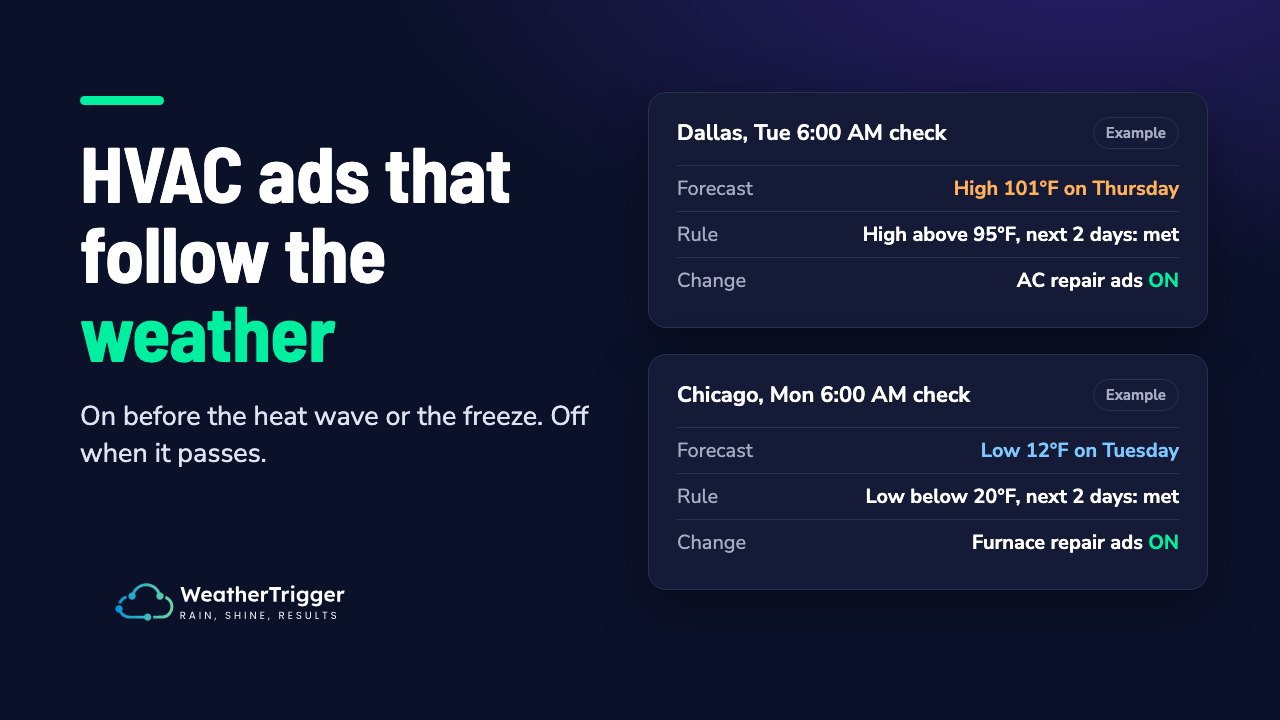
Strategy: Neither Meta nor Google Ads offers weather as a targeting option, so weather-triggered ads need an outside tool. It checks the weather for each location and switches campaigns or ad sets on or off through the platform’s API. You can build this yourself with Google Ads scripts or a Make.com scenario, or use a dedicated tool like WeatherTrigger for Meta ads.
Why it works: Your ads run when the weather makes them relevant and stay off when it doesn’t.
Example:
- A sunscreen brand might only run ads in places where it’s sunny and over 25°C.
- A food delivery service might switch on ads when rain is forecast in its delivery areas.
4. Join weather conversations
Strategy: When the weather is what everyone is talking about, join in where it makes sense for your brand.
Example: A homewares brand might post a short video of blankets, candles and warm lighting during the first proper cold snap of winter.
5. Tie offers to the weather
Strategy: Link a discount or offer to a weather event.
Why it works: The offer feels timely and relevant, and it has a natural end date.
Example:
- “Rainy weekend? 20% off hot drinks until Sunday.”
- “It’s 35°C in Sydney. Free delivery on ice cream today.”
A real example: Pantene “Haircast”
In the US in 2013, Pantene worked with The Weather Channel and Walgreens on a campaign called “Haircast”. When the weather in a user’s area was humid or dry and hot, The Weather Channel’s mobile app and website showed Pantene ads for the matching hair product, along with a coupon redeemable at Walgreens.
According to the campaign’s award submission, Pantene sales at Walgreens rose 24% year on year over July and August 2013, against a 10% target (trade press coverage). That figure comes from the brand’s own submission, and the campaign ran in a weather app rather than on Facebook or Google, but it shows how directly weather can be tied to a product need.
Tools for weather-triggered marketing
- WeatherTrigger: pauses and resumes Meta (Facebook and Instagram) ad sets based on live weather and forecasts. Google Ads support is coming soon.
- OpenWeather: a weather API you can use for your own integrations.
- Make.com: a no-code automation tool that can connect a weather API to the Meta Marketing API.
- Google Ads scripts: JavaScript that runs inside Google Ads and can pause or enable campaigns based on data from an external weather API.
Best practices
- Be relevant, not opportunistic. During severe weather, avoid promotions that could look insensitive.
- Test it. Compare weather-triggered campaigns against always-on campaigns before you decide they work. Our guide to measuring weather-triggered ads explains how.
- Use local thresholds. A “cold day” in Brisbane is not a cold day in Hobart.
- Mind your tone. Light-hearted content suits a drizzly afternoon, not a flood.
- Keep the basics right. Weather timing helps good creative, targeting and conversion tracking. It doesn’t replace them.
The bottom line
Weather changes the mood of the people scrolling past your content, and research shows rain’s effect even spreads to their friends. For marketers, that means you can:
- Plan content around the forecast
- Match creative to the mood the weather creates
- Run ads when the weather makes them relevant
So next time you check the weather, don’t just decide what to wear. Decide what to post.