Weather-Triggered Advertising: The Complete Guide (2026)
Weather changes what people buy and when they buy it. Weather-triggered advertising, often just called weather ads, uses that: your ads run, stop or change when the weather in a place meets conditions you set. A roofer’s storm-repair ads run the day after heavy rain. A café’s iced-coffee ads run when it’s over 30°C. Neither spends money on days when the weather makes the offer irrelevant.
This guide covers what weather-triggered advertising is, what the evidence says, how it works on each channel, and how to set up your first rule.
What is weather-triggered advertising?
Weather-triggered advertising (also called weather-based advertising, weather ads or weather targeting) automatically changes your ads based on the weather in the places you advertise. It has three parts:
- A weather source. Current conditions and forecasts for each location, from a provider such as OpenWeather.
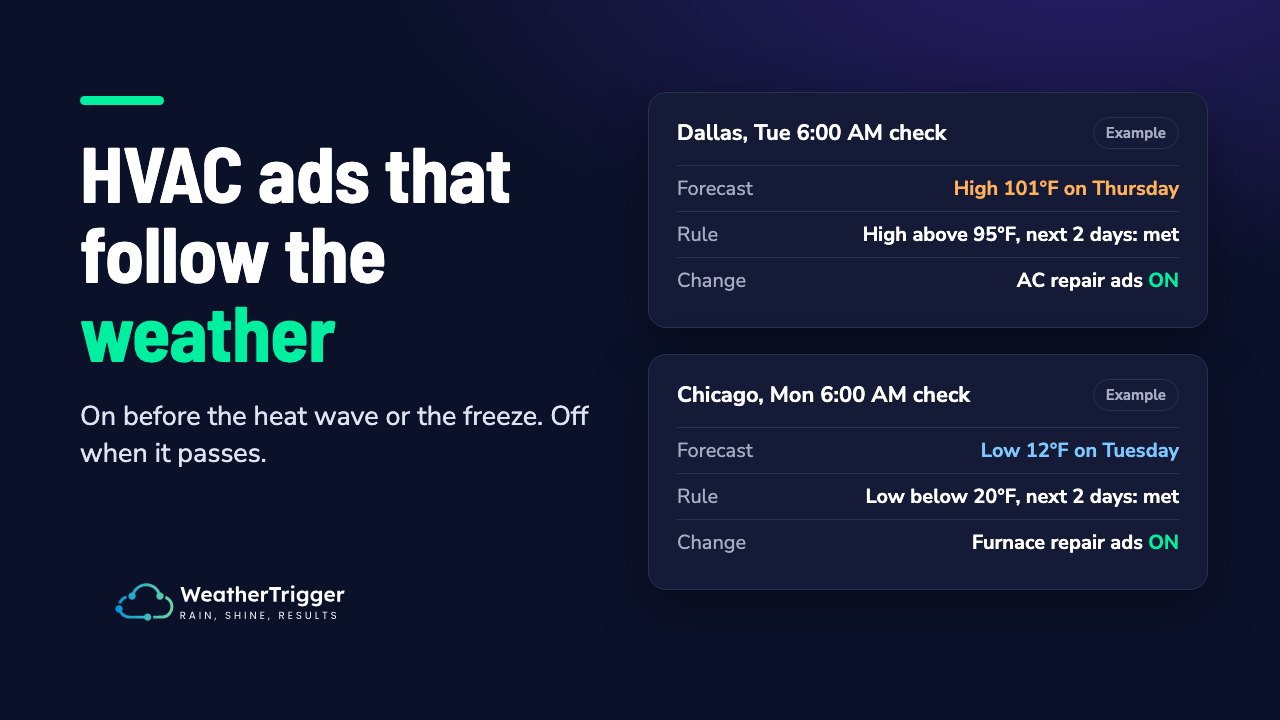
- Rules. Conditions and the action to take, for example “when rain of 10 mm or more is forecast in Sydney today, run the rainwear ad set”.
- An automated action. Something that makes the change in your ad account: a tool, a script, or the platform’s API.
The action can be switching ads on and off, raising or lowering budgets, changing bids or targets, or swapping creative. Which ones are available depends on the channel and the tool.
It’s different from seasonal advertising. Seasonal campaigns run on a calendar (winter coats in June). Weather-triggered campaigns run on the actual weather, which rarely matches the calendar. An early cold snap in April or a warm week in July moves demand, and a calendar can’t see it coming.
Why weather-triggered ads work
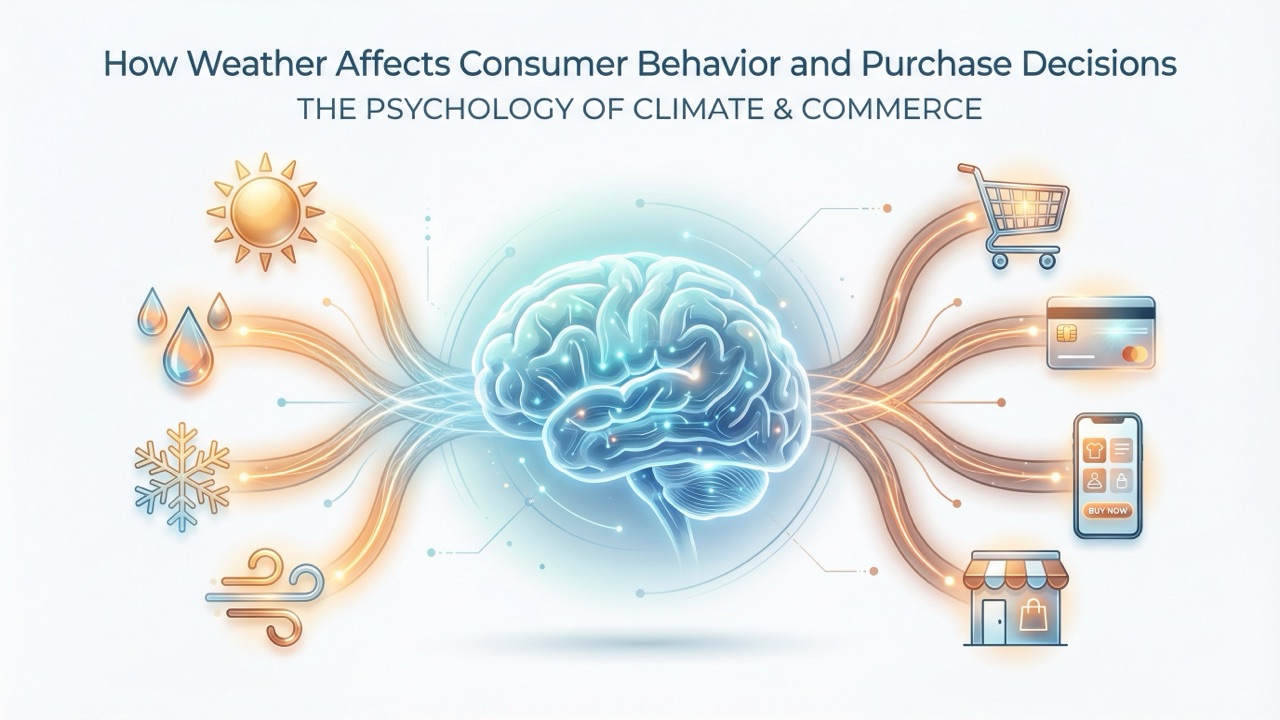
Weather changes demand, and it changes it locally and at short notice. The best evidence:
- Rain moves spending online. Across more than a trillion US retail site visits, rain lifted online spending by up to 4.4%, with about double the effect at weekends (Adobe and The Weather Company, 2023).
- Heat moves spending in time. On days of 35°C or more in Sydney, Melbourne and Adelaide, daytime card spending fell about 12% and evening spending rose about 5% (Westpac data, 2025).
- Weather changes ad response. In a field experiment with more than 6 million mobile users, promotions got a 1.2 times higher and 73% faster response on sunny days than on cloudy days.
- Weather-matched creative performs better. Molson Coors’ weather-specific Facebook ads had a 67% lower cost per click than its generic ads (2013, agency-reported).
Much of the weather effect is timing: demand arrives earlier or later than usual rather than appearing from nowhere. That’s exactly the problem weather triggers solve. They put your ads in front of people when the demand arrives, and stop spending when it isn’t there.
Be wary of the big numbers that circulate on this topic. Claims like “weather influences 62% of purchases” or “weather ads improve conversions by 300%” can’t be traced to any study. We’ve collected the sourced evidence, and the claims that don’t hold up, in what the research says about weather and consumer behaviour.
Types of weather triggers
| Trigger | Typical use |
|---|---|
| Temperature (current, daily maximum or minimum) | Cold drinks and cooling above a threshold, heating and winter gear below one |
| Rain chance | Indoor products and delivery when rain is likely |
| Rain or snow amount | Storm repairs, drainage, rainwear, online retail on wet weekends |
| Wind and gusts | Storm damage, outdoor events, boating |
| Humidity | Dehumidifiers, pest control, hair care |
| Cloud cover and visibility | Outdoor activities, travel, solar |
| Severe weather warnings | Emergency services, insurance, supplies |
| Pollen, air quality, UV (some tools) | Allergy relief, air purifiers, sun protection |
Rules can look at different time windows: conditions right now, today’s forecast, the next few days, or what happened in the past 24 hours. “Past 24 hours” suits businesses whose demand comes after the weather, like roof repairs after a storm. “Next few days” suits products people buy ahead, like heaters before a cold week.
Use local units and thresholds. Many guides online use Fahrenheit and US cities, so a threshold copied from them may be wrong for your market. For the exact conditions and windows a WeatherTrigger rule can use, with example rules by trade, see weather triggers explained.
How it works on each channel
Meta (Facebook and Instagram)
Meta has no weather targeting, and its automated rules can’t use weather. Weather-triggered Meta ads switch ad sets on and off, change budgets, or rotate creative through the Marketing API.
The main thing to plan around is the learning phase. Resuming an ad set that has been paused for 7 days or more restarts learning. Pausing an ad set inside a campaign budget moves its spend to the other ad sets instead of saving it. Details in our guide to weather targeting on Meta.
Google Ads
Google Ads has no weather targeting either, and Google’s own weather script has been removed from its documentation. Smart Bidding also ignores location bid adjustments, so the old “raise bids when it’s cold” approach does nothing on most campaigns.
What works instead: budgets, CPA and ROAS targets, seasonality adjustments for forecast events, and switching ad groups or asset groups. Details and a working script in our guide to weather targeting on Google Ads.
Programmatic and digital out-of-home
Weather targeting is most mature in programmatic advertising. Weather data from providers such as The Weather Company and AccuWeather is available in major demand-side platforms, and digital billboards can switch creative by conditions.
Some of the best-documented weather campaigns ran on these channels:
- Guinness, Australia (2023): digital billboards near pubs in four cities switched on below 7°C. The campaign reported a 13% year-on-year increase in consumption and won a JCDecaux programmatic award.
- Pantene “Haircast”, US (2013): humidity-triggered ads in The Weather Channel app with a Walgreens coupon lifted Pantene sales at Walgreens 24% year on year, according to its award submission.
Email and SMS
Some email and SMS platforms can change content or send timing by weather through third-party integrations. It’s useful for businesses with a customer list in weather-sensitive categories, but it usually needs a separate tool or custom work.
Industries that benefit most
| Industry | Weather that moves demand | Example rule |
|---|---|---|
| Roofing, plumbing, restoration | Heavy rain, storms, gusts | Run storm-repair ads for 3 days after 20 mm+ of rain |
| Heating and cooling | Heatwaves, cold snaps | Run air-conditioning ads when 35°C+ is forecast |
| Food, drink and delivery | Heat, rain | Run iced-drinks ads above 30°C, delivery ads in rain |
| Retail and e-commerce | Rain, temperature swings | Run rainwear ads on wet weekends |
| Pools and garden | Warm, dry spells | Run pool-chemical ads during a warm, dry week |
| Travel and leisure | Rain, cold, sunny weekends | Run getaway ads when a wet weekend is forecast |
| Insurance and emergency supplies | Severe weather warnings | Run cover or supplies ads when a warning is issued |
More detail in 7 industries that benefit most from weather-triggered ads.
Setting up your first rule
- Start with your sales data. Look for days when sales rose or fell sharply, and check what the weather was doing. Pick one condition that clearly moves demand.
- Choose the action. For a weather-dependent offer, switch a dedicated ad set on and off. For a campaign that runs all the time, raise or lower its budget instead.
- Set it up by location. Weather is local. Create rules for the places you actually serve, and target each ad set to the area its rule checks.
- Match the creative. Ads that reflect the weather people are experiencing (“Storm damage? We can be there today”) perform better than generic ones.
- Decide how it switches back. Keep ads running a little after the weather clears if demand lingers (it does after storms). Avoid rules that flip on and off with every small change.
- Measure against a control. Leave a similar region without the rule, then compare. See weather ad measurement.
Common mistakes
- Flipping on every small change. Rules that switch ads several times a day make delivery unstable. Check the forecast on a sensible schedule and switch only when conditions clearly change.
- Pausing for long periods. On Meta, a pause of a week or more restarts learning. If a rule could hold an ad set off for weeks, use budget changes or keep a small always-on ad set.
- Pausing inside a campaign budget. The other ad sets absorb the spend, so you don’t save anything.
- Splitting into too many small ad sets. Each one needs enough budget to get results. Start with one or two weather ad sets.
- Using national rules. It can be raining in Melbourne and 35°C in Brisbane. Rules should follow the weather where your customers are.
- Trusting ROAS alone. Weather creates demand by itself, so weather-triggered ads always look good in standard reports. Use a holdout to see the real effect.
Privacy
Weather rules use public forecasts for places, not data about individuals. The location targeting they rely on still has to follow each platform’s advertising policies and local privacy law, as any location-targeted campaign does.
Tools and costs
- Do it yourself: a Google Ads script or a Make.com scenario for Meta is free apart from your time, but you maintain it.
- Dedicated tools: pricing ranges from flat monthly fees to a percentage of ad spend. We compare the main options in WeatherAds alternatives.
- WeatherTrigger: switches Meta ad sets on and off by local weather, with conditions for temperature, rain, snow, wind, humidity, cloud and severe weather alerts. Every check is logged. Google Ads support is coming soon. Plans are $19, $49 and $99 a month, and every plan starts with a 30-day free trial with no card needed.
Get started
Pick one product, one location and one weather condition that clearly moves your sales. Run it for a month against a control, and expand from there.
Start a 30-day free trial of WeatherTrigger. No card needed.
Related reading
- How Weather Affects Consumer Behaviour: What the Research Says
- Weather Targeting for Facebook and Meta Ads
- Weather Targeting for Google Ads
- Weather Ad Measurement
- 7 Industries That Benefit Most from Weather-Triggered Ads
- Weather-Triggered Ads for Travel and Tourism
- How Climate Change Is Quietly Changing Advertising