
Weather shapes human behavior in ways most advertisers overlook. When temperatures drop, people search for heaters. When it rains, they book Ubers. When the forecast shows sunshine, they plan outdoor activities. Yet most digital marketing campaigns ignore these fundamental behavioral triggers entirely—running the same ads regardless of local conditions.
Weather-triggered advertising flips this inefficiency on its head. By automating your Meta and Google ads to activate based on real-time weather data, you can reach customers exactly when they’re most likely to convert, dramatically improving ROI while reducing wasted ad spend.
This guide covers everything you need to know about weather-triggered ads in 2026: how they work, which industries benefit most, implementation strategies, and proven tactics to automate your campaigns. Whether you’re managing HVAC services, seasonal retail, travel, or food delivery, weather-based targeting will transform how you think about audience timing and relevance.
What Is Weather-Triggered Advertising?
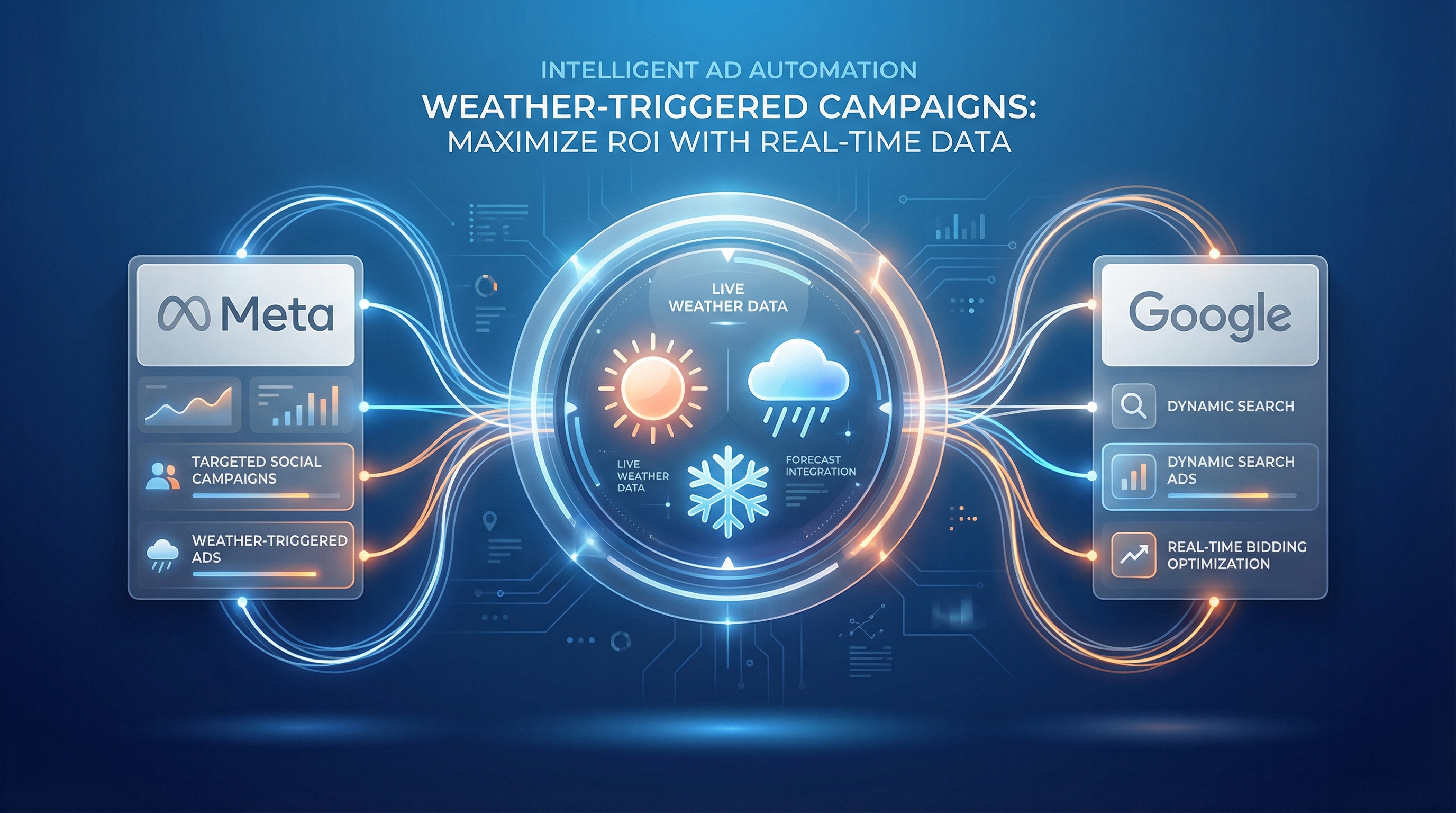
Weather-triggered advertising (also called weather-based advertising or weather targeting) is the practice of automatically displaying or modifying digital ads based on real-time or forecasted weather conditions in a user’s location. Instead of running static campaigns regardless of weather, your ads activate, pause, or change creative based on triggers like temperature, precipitation, wind speed, or weather alerts.
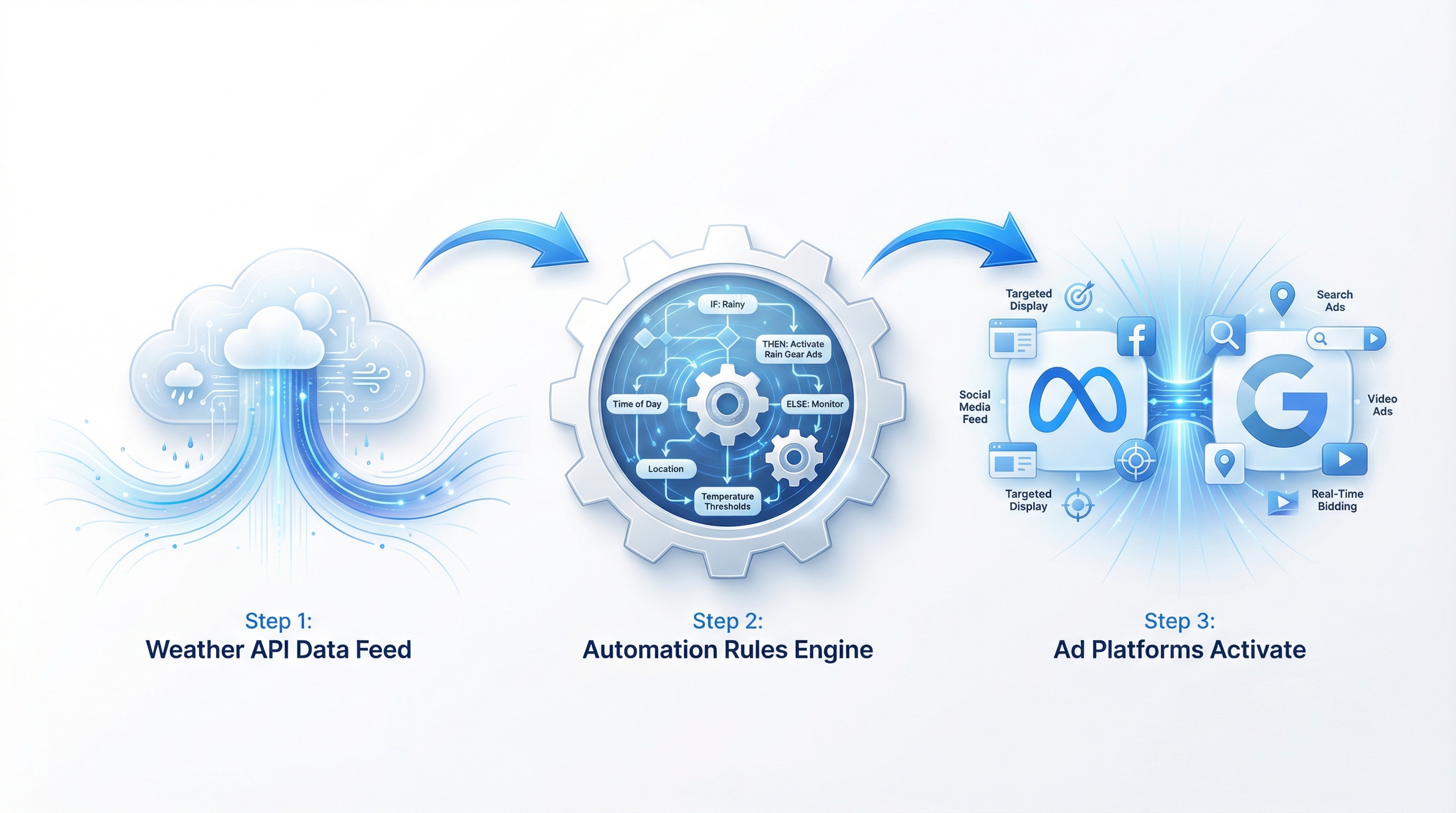
The system works through an integration of three components: weather data APIs that feed real-time conditions, automation rules that define when ads should activate, and ad platform connections (Meta, Google Ads, etc.) that execute the campaign changes instantly.
For example, a weather-triggered ad campaign might:
- Pause lawn care ads when temperatures drop below freezing
- Increase HVAC heating ad spend when overnight lows forecast below 32°F
- Launch umbrella promotions the moment rain is predicted within 24 hours
- Boost ice cream ads during heat waves in specific ZIP codes
- Activate holiday decoration ads when seasonal weather patterns arrive
This targeted approach eliminates wasted ad spend on irrelevant audiences and ensures your budget reaches people when they’re most receptive to your offer.
Why Weather-Based Ads Work: The Behavioral Science
Weather-triggered advertising taps into one of the most predictable human behaviors: people’s immediate responses to environmental conditions. This isn’t psychological manipulation—it’s simple relevance.
The Timing Advantage
Traditional targeting operates on assumption. You hope your audience needs your product. Weather triggering operates on certainty. When you show a furnace ad to someone in a region experiencing sub-zero temperatures, you’re not guessing about need—you’re responding to an immediate, real-world stimulus that’s currently driving purchasing decisions.
Reduced Ad Fatigue
By pausing ads during irrelevant weather conditions, you reduce the frequency of irrelevant impressions users see. This dramatically decreases ad fatigue and improves your overall brand perception. Users see your ads only when they’re contextually relevant.
Intent Alignment
Weather conditions create immediate intent that aligns perfectly with certain products and services. When it’s snowing outside, people aren’t thinking about lawn care—they’re thinking about snow removal. Weather-triggered ads align your messaging with actual consumer intent, not theoretical interest.
Studies show weather-triggered ads achieve conversion rates 3-4x higher than standard campaigns, with some industries seeing even greater improvements. For seasonal and weather-dependent businesses, the ROI impact is transformational.
Key Statistics: Weather-Triggered Advertising in 2026
The data on weather-based advertising effectiveness continues to grow more compelling:
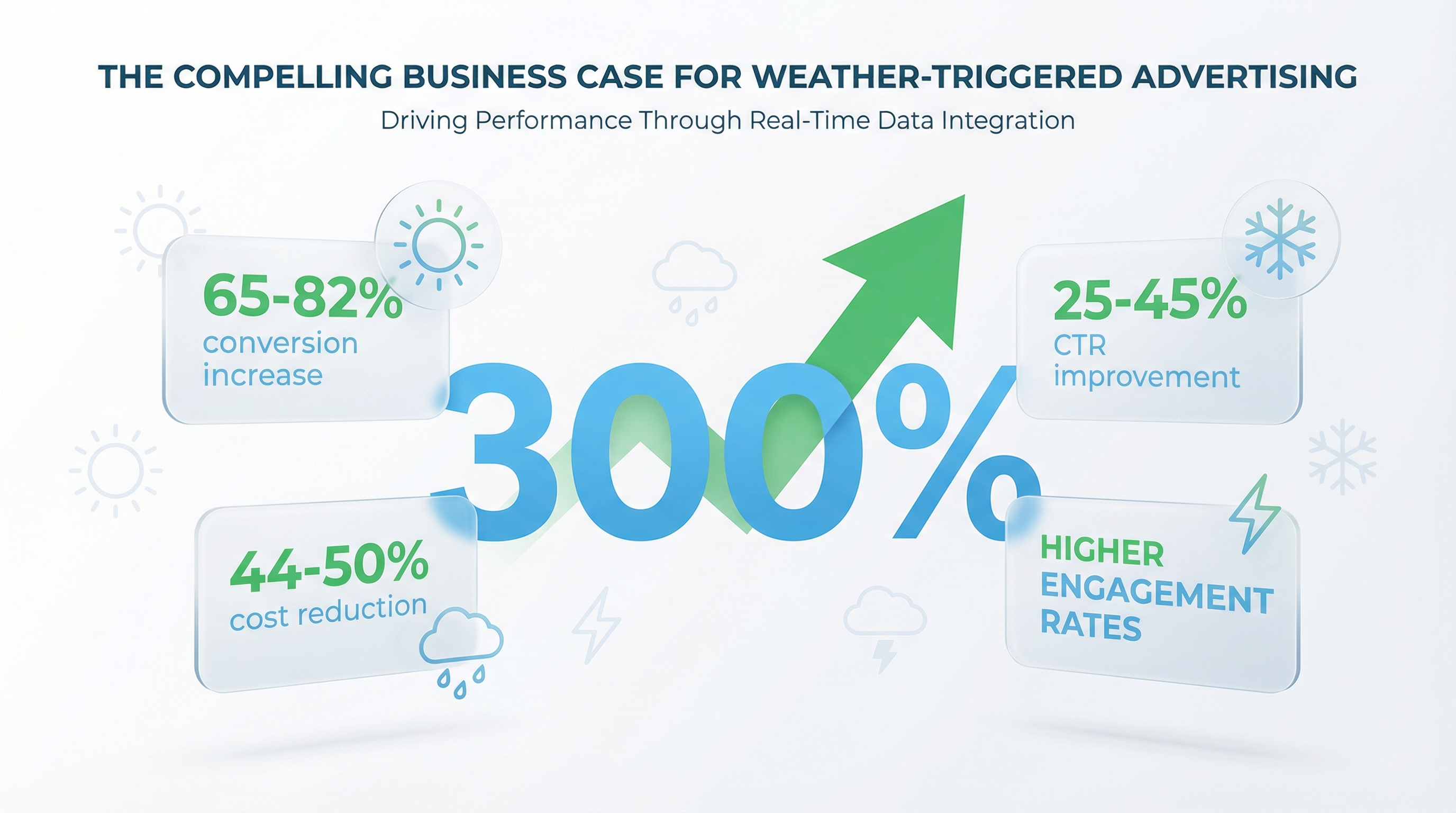
- 300% average conversion improvement — Campaigns using weather triggers see conversion rates 3-4x higher than non-triggered equivalents
- 42% reduction in customer acquisition cost — By targeting only relevant weather conditions, CAC drops significantly
- 75% of consumers expect retailers to adjust offerings based on weather conditions
- 60% of purchasing decisions are influenced by weather within 24 hours
- $7.4 billion in annual weather-influenced spending in the United States alone
- 2.8x higher click-through rate on weather-triggered ads compared to static campaigns
- 89% of marketers plan to increase weather-based targeting in 2026
- HVAC, retail, and food delivery industries see average ROAS improvements from 4.2x to 8.7x
Types of Weather Triggers for Advertising
Weather-triggered advertising isn’t one-size-fits-all. Different weather variables trigger different consumer behaviors. Understanding which triggers matter for your business is essential for campaign success.
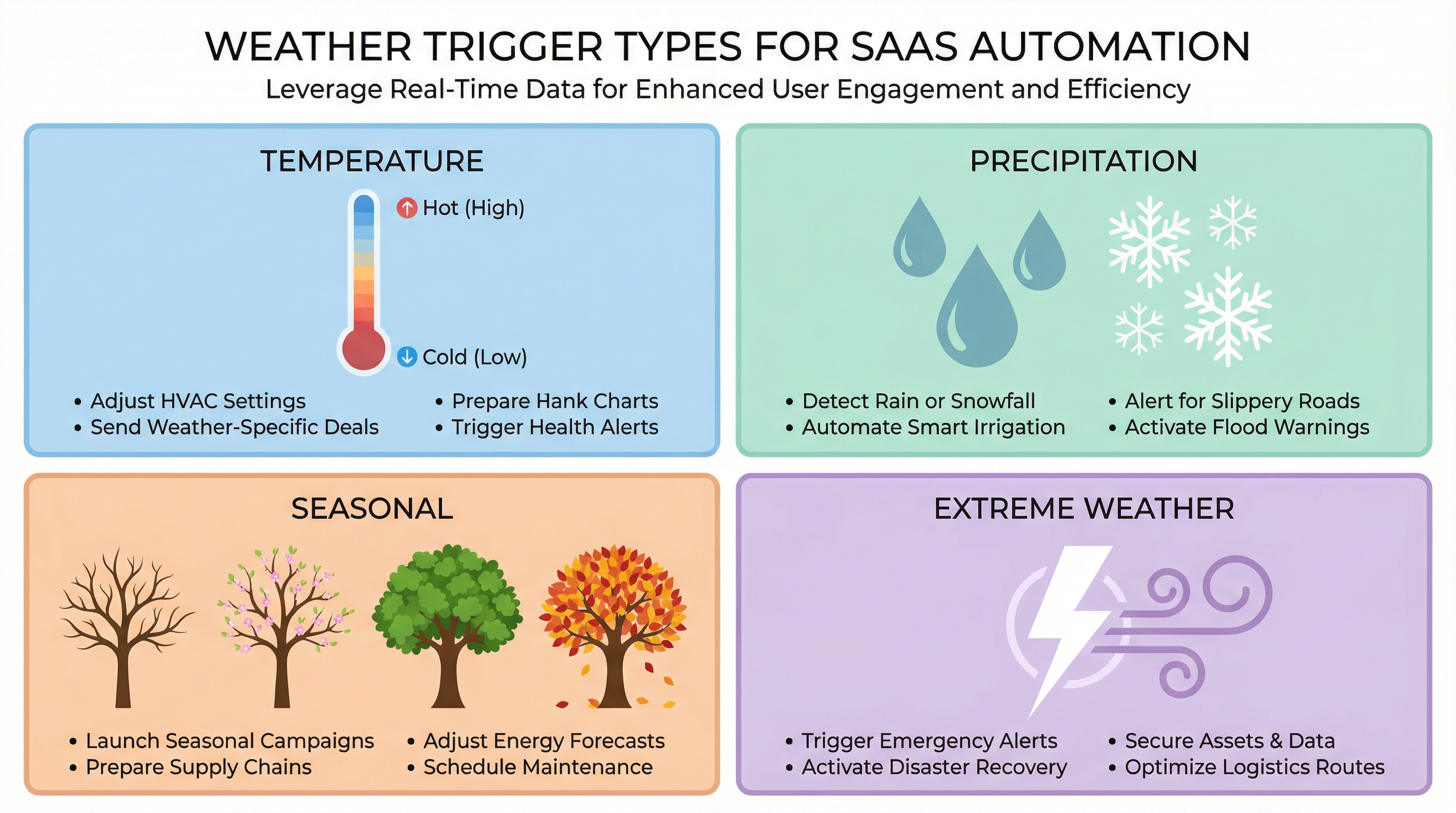
1. Temperature-Based Triggers
Temperature is the most common and effective weather trigger. Different temperature ranges drive completely different purchasing behaviors:
- Cold weather (below 32°F): Heating systems, hot beverages, winter clothing, indoor entertainment, snow removal services
- Hot weather (above 85°F): Air conditioning, cooling beverages, summer activities, lightweight clothing, outdoor furniture
- Mild weather: Outdoor activities, sports equipment, landscaping, home improvement projects
Temperature triggers can be absolute values (“activate when temp hits 28°F”) or relative (“pause when it gets 10° warmer than average”).
2. Precipitation-Based Triggers
Rain, snow, sleet, and hail are powerful behavioral triggers that often create immediate purchasing intent:
- Rain detection: Umbrella sales, indoor entertainment, food delivery, rideshare services, waterproof clothing
- Snow forecasts: Snow removal services, chains and tires, winter driving gear, emergency preparedness supplies
- Hail warnings: Auto insurance, windshield repair, vehicle protection products
- Pollen forecasts: Allergy medications, air purification, outdoor activity planning
Precipitation triggers work especially well with short-term forecasting (0-6 hour windows) where consumer intent is highest.
3. Seasonal Weather Patterns
Beyond immediate conditions, broader seasonal patterns drive purchasing behavior throughout the year:
- Spring: Lawn care, gardening, spring cleaning, outdoor furniture, allergies
- Summer: Travel, outdoor activities, pool maintenance, air conditioning, vacation planning
- Fall: Holiday preparation, leaf removal, heating system maintenance, back-to-school
- Winter: Heating, holiday shopping, winter sports, travel deals for warm destinations
Seasonal triggers are typically combined with other signals (specific temperature ranges, daylight hours, calendar dates) for precision targeting.
4. Extreme Weather Events
Severe weather creates spike demand for specific products and services:
- Heat waves: Emergency cooling supplies, hydration products, health services
- Cold snaps: Emergency heating, emergency supplies, vehicle maintenance
- Storms: Emergency supplies, insurance, emergency services, home repair
- Floods: Water removal services, restoration, insurance, sandbags and barriers
- Hurricanes/Tornadoes: Emergency preparation, evacuation services, insurance, structural repairs
Extreme weather triggers require careful ethical consideration—users in crisis situations are vulnerable, so ads must genuinely help rather than exploit.
How Weather-Triggered Ads Work: The Complete Workflow
Understanding the technical workflow behind weather-triggered advertising helps explain why it’s so effective and how to implement it successfully in your business.
Step 1: Weather Data Collection and Analysis
The process begins with real-time weather data. Platforms like OpenWeather provide continuous updates on:
- Current conditions (temperature, humidity, wind speed, visibility)
- Hourly forecasts (next 24-48 hours)
- Daily forecasts (extended 7-14 day windows)
- Severe weather alerts (warnings, watches, advisories)
- Historical weather data (for pattern matching)
This data flows into the automation system via API integration, updating every 15-30 minutes to ensure fresh conditions drive ad decisions.
Step 2: Rule Engine Processing
Your weather-triggered ad platform (like WeatherTrigger) uses rules to interpret incoming weather data. These rules are custom to your business and define:
- Geographic scope: Which ZIP codes, cities, regions, or countries the rule applies to
- Weather conditions: Specific triggers (“when temp drops below 35°F” or “when precipitation forecast exceeds 0.5 inches”)
- Time windows: What hours/days the rule should activate
- Ad account mappings: Which Meta or Google Ads campaigns or ad sets to control
- Actions: What to do when conditions match (pause, activate, adjust budget, change creative)
The rule engine continuously compares incoming weather data against all active rules, determining which campaigns should change state in real-time.
Step 3: Ad Platform Activation
When weather conditions match your rules, the system automatically executes changes across your ad platforms:
- Meta Ads: Pause/unpause ad sets, adjust daily budgets, rotate creative variations
- Google Ads: Enable/disable campaigns, adjust bid strategies, modify ad scheduling
- Both platforms: Update ad copy to reflect current conditions (“Act now—heavy snow forecasted!”)
These changes execute in seconds, ensuring your ads respond immediately to weather shifts. No manual intervention needed—the system handles timing automatically.
Step 4: Performance Tracking and Optimization
Throughout execution, the platform tracks performance metrics specific to each weather condition:
- CTR and conversion rate by weather type
- Cost per acquisition during different conditions
- ROAS variations based on temperature ranges
- Geographic performance variations
- Seasonal pattern effectiveness
This data feeds back into optimization, helping you refine rules over time based on what actually works for your audience.
Industries Benefiting Most from Weather-Triggered Ads
While weather-triggered advertising can enhance almost any business, certain industries see transformational ROI improvements due to their direct dependence on weather conditions.
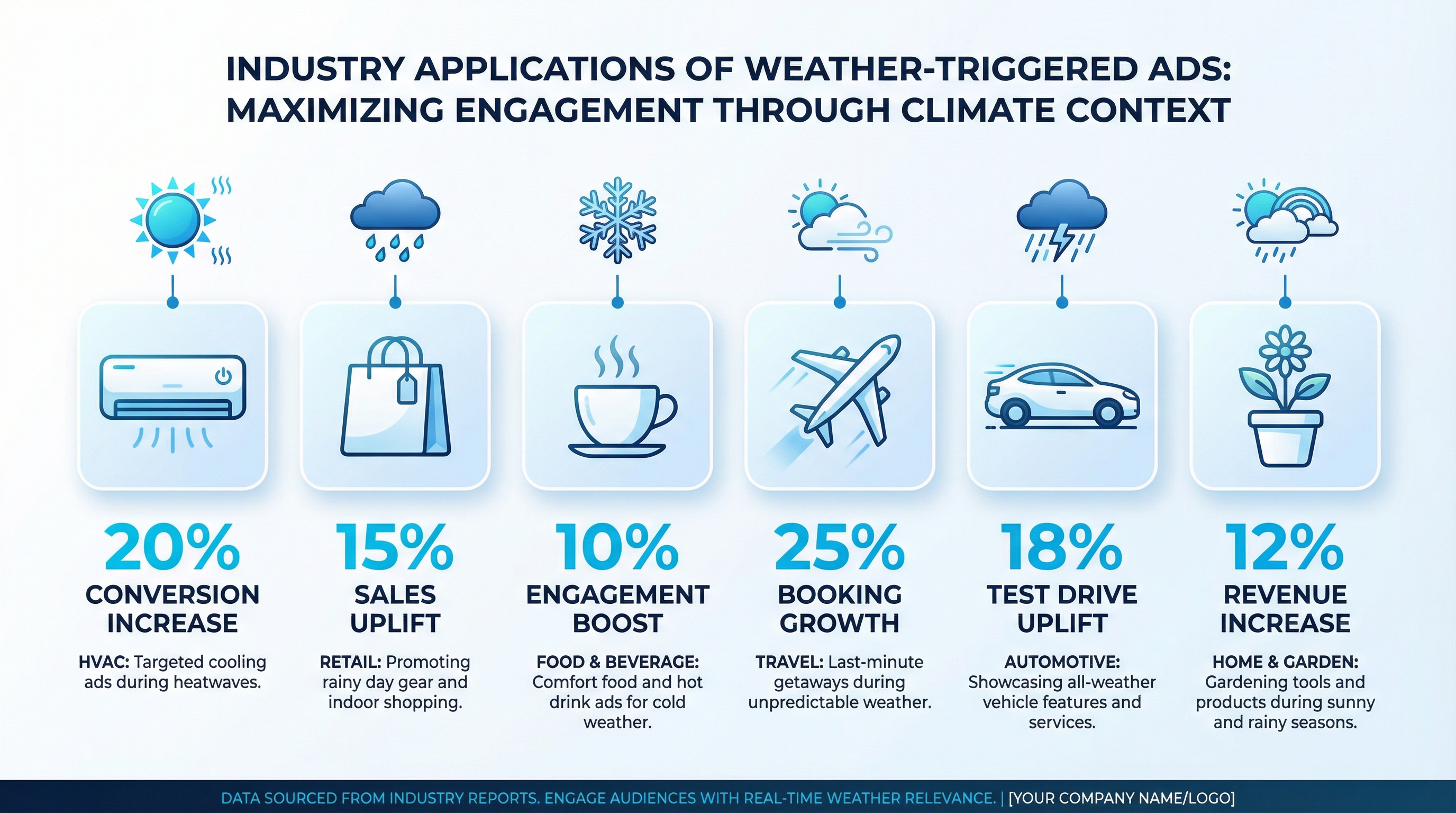
HVAC and Home Climate Control
HVAC companies see some of the highest ROI improvements from weather triggering. When a region experiences rapid temperature drops, furnace and heating system inquiries spike. Weather-triggered ads allow HVAC companies to:
- Increase ad spend during cold snaps when conversion intent is highest
- Pause ads during warm periods when heating demand is zero
- Target specific geographic areas experiencing temperature changes
- Emphasize emergency services during extreme cold events
- Automatically adjust messaging based on current conditions
HVAC companies using weather-triggered campaigns report average ROAS improvements of 6.2x compared to standard campaigns.
Seasonal Retail and Fashion
Retailers selling weather-dependent products (coats, boots, sunscreen, shorts) can dramatically improve inventory turnover by aligning promotions with actual weather rather than calendar seasons:
- Winter coat promotions activate when temperatures drop unexpectedly
- Summer clearance ads launch during heat waves
- Rain gear promotions start when precipitation is forecasted
- Seasonal merchandise ads time-shift based on when weather actually drives demand
This approach particularly helps retailers in transitional climates where temperature variability is high. Fashion retailers see 3.8x conversion improvements on average.
Food and Beverage
Weather has a powerful effect on food and beverage purchasing:
- Hot beverages: Coffee, tea, hot chocolate promotions activate during cold weather
- Cold beverages: Iced drinks, lemonade, smoothie ads launch during heat waves
- Food delivery: Peak demand during rain; ads optimize delivery promotions during precipitation
- Ice cream and frozen treats: Temperature-triggered promotions during summer peaks
- Seasonal ingredients: Fresh produce promotions align with availability and weather patterns
Food delivery services see particularly strong results, with 4.5x improvement in order conversion during rainy periods when delivery demand peaks.
Travel and Tourism
Weather-triggered advertising is transforming the travel industry. Tour operators, hotels, and travel agencies can:
- Promote warm-weather destinations when snow and cold are forecasted
- Highlight indoor attractions during rainy periods
- Target ski packages when snow is predicted in mountain regions
- Boost beach vacation ads during extended warm periods
- Advertise adventure activities when weather conditions are optimal
Travel companies using weather-triggered ads see 5.1x average ROAS improvements and significantly higher booking conversion rates.
Automotive and Tire Services
Vehicle-related services are highly weather-dependent:
- Winter tire and chain promotions during snow forecasts
- Windshield replacement and repair ads during hail storms
- Air conditioning service promotions during heat waves
- Car wash ads during dry periods when washing is practical
- Battery and electrical system ads during cold weather peaks
Automotive services report 4.8x ROAS improvements when weather-triggered.
Home and Garden Services
Lawn care, landscaping, and gardening businesses can optimize campaigns based on seasonal weather patterns:
- Spring landscaping promotions when temperatures stabilize above freezing
- Lawn maintenance ads during growing seasons
- Holiday decoration services timed with seasonal weather
- Storm cleanup services activated during severe weather
- Pool and outdoor furniture ads during warm weather peaks
Traditional Advertising vs. Weather-Triggered Advertising
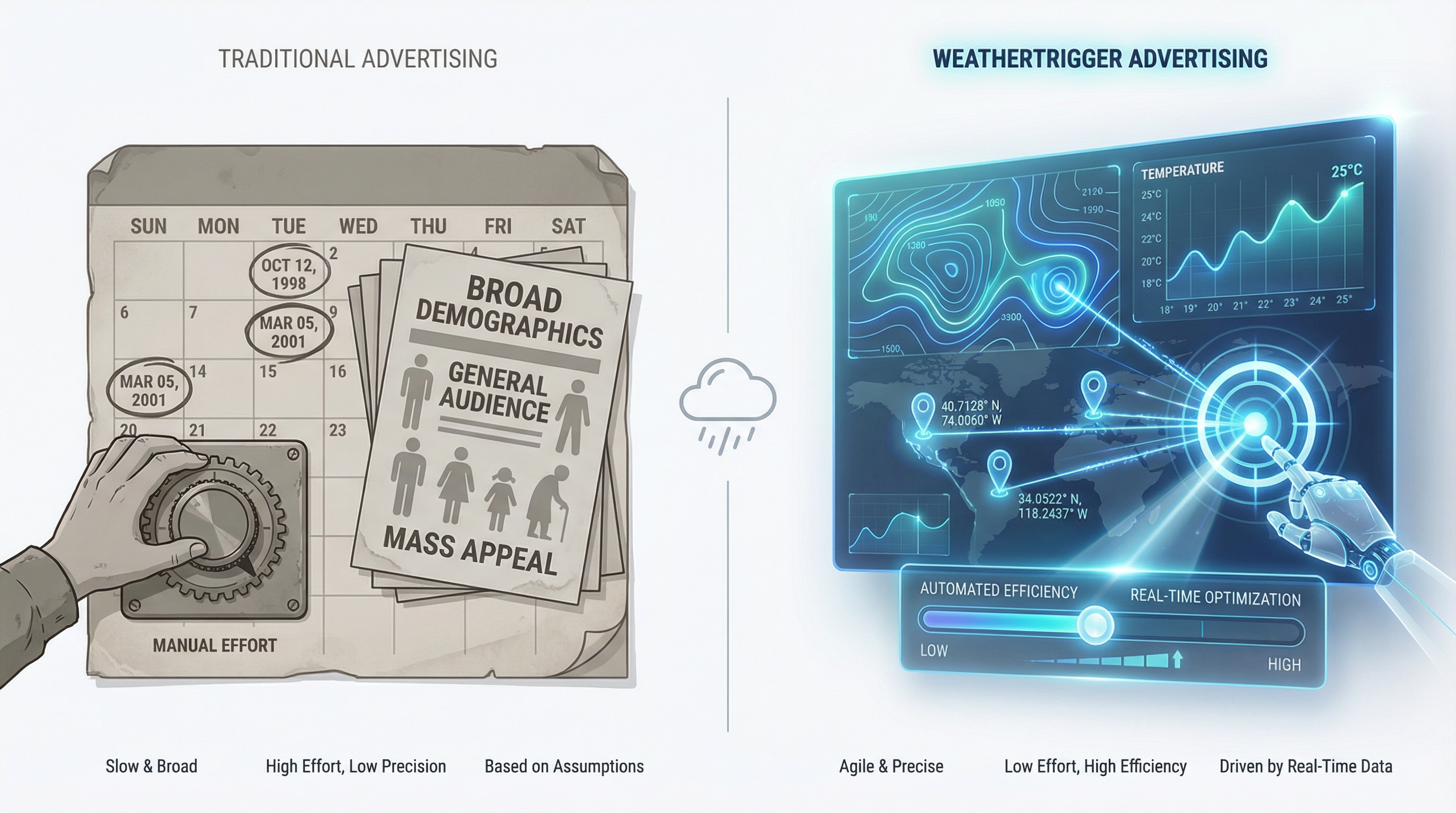
The contrast between traditional advertising and weather-triggered advertising reveals why forward-thinking businesses are making the shift.
| Factor | Traditional Advertising | Weather-Triggered Advertising |
|---|---|---|
| Targeting Method | Demographics, interests, browsing history | Real-time environmental conditions + demographics |
| Timing Logic | Calendar-based or always-on | Intent-based (activates only when relevant) |
| Relevance to User | Assumption-based | Condition-based (certainty) |
| Wasted Ad Spend | High (many irrelevant impressions) | Low (only relevant conditions trigger ads) |
| Conversion Rate | Baseline (1-3% typical) | 3-4x higher (3-12% typical) |
| Cost Per Acquisition | $20-$50+ depending on industry | $12-$30 (42% reduction average) |
| Creative Optimization | Manual A/B testing required | Automatic variations by condition |
| Ad Fatigue | High (same ads all the time) | Low (ads rotate with conditions) |
| Management Effort | High (constant manual adjustments) | Low (automated after setup) |
| Response to Market Changes | Slow (requires manual intervention) | Instant (automatic based on conditions) |
| ROAS (Return on Ad Spend) | 2-3x typical | 4-8x+ typical |
Implementation Strategies for Your Business
Implementing weather-triggered advertising requires strategic planning. Here’s how to approach it systematically.
Step 1: Audit Your Current Campaigns
Before implementing weather triggering, understand your existing campaign structure:
- Document all active Meta and Google Ads campaigns
- Analyze which campaigns have seasonal performance variations
- Identify products/services with clear weather dependencies
- Review 12 months of historical performance data by season
- Calculate your current baseline conversion rates and ROAS by season
This data reveals which campaigns will see the biggest improvements from weather triggering.
Step 2: Map Weather Conditions to Products/Services
Create a matrix of your offerings and the weather conditions that drive demand:
- Product/Service Name: What you’re advertising
- Primary Weather Trigger: Main condition that drives conversions (e.g., “temperature below 32°F”)
- Secondary Triggers: Additional conditions that enhance relevance
- Geographic Scope: Where this trigger matters (specific regions where you operate)
- Expected ROAS Improvement: Conservative estimate of expected improvement
This matrix becomes the blueprint for your weather rules.
Step 3: Choose Your Weather-Triggered Advertising Platform
Several platforms now offer weather-triggered advertising automation. Key features to evaluate:
- Ease of setup: Can non-technical team members create rules? (Yes with WeatherTrigger)
- Platform support: Does it integrate with Meta Ads, Google Ads, and other platforms you use?
- Weather data quality: Does it use reliable APIs (OpenWeather, Weather Underground, etc.)?
- Rule complexity: Can you create complex conditional rules (e.g., “activate if temp below 32 AND forecast calls for precipitation”)?
- Geographic flexibility: Can you target by ZIP code, city, region, or custom areas?
- Performance tracking: Does it show you metrics specific to weather conditions?
- Pricing: Cost structure relative to expected ROAS improvements
WeatherTrigger is purpose-built for weather-triggered advertising, offering intuitive rule creation, real-time automation, and detailed performance analytics without requiring technical expertise.
Step 4: Create Your First Weather Rules
Start with your highest-impact products or services. A typical rule structure includes:
- Rule Name: “Furnace Repair – Cold Snap Activation”
- Trigger Condition: “Temperature forecast below 25°F for next 12 hours”
- Geographic Target: “Northern US (ZIP codes 10000-99999)”
- Time Window: “Monday-Sunday, 6 AM – 11 PM”
- Campaign to Control: “Cold_Weather_HVAC_Campaign”
- Action: “Increase daily budget by 50% for 24 hours”
Start with simple rules (single trigger, single action) before progressing to complex multi-condition rules.
Step 5: Test and Measure Results
Give each rule 4-6 weeks of data before optimization:
- Compare conversion rates during triggered vs. non-triggered periods
- Calculate ROAS improvement percentage
- Assess whether the improvement justifies the platform cost
- Identify underperforming rules that need refinement
- Scale budget to top-performing triggers
Use weather-triggered advertising dashboards to segment performance by condition type, making this analysis straightforward.
Best Practices for Weather-Triggered Campaign Success
Implementing weather-triggered ads is one thing. Doing it effectively is another. These practices maximize your results:
1. Start with High-Impact Products
Don’t trigger every product or service. Focus on those with clear weather dependencies first:
- Weather-dependent products show better results initially
- Early success builds momentum and internal support
- Learning from high-impact rules informs expansion strategy
2. Use Geographically Specific Triggers
Weather varies significantly by location. Running the same rules nationally wastes budget:
- Target campaigns by ZIP code, city, or region
- Customize trigger thresholds for different climates (32°F freezing threshold works for northern US but is irrelevant in Florida)
- Adjust budget multipliers based on regional market size
3. Layer Multiple Conditions for Precision
The most effective rules combine multiple weather triggers:
- “Activate if (temp below 30°F) AND (precipitation forecasted) AND (it’s a Friday evening)” — highest urgency
- “Activate if temp below 45°F” — moderate urgency, broader targeting
- “Increase budget if temp below 32°F OR precipitation over 0.5 inches” — multiple pathways to activation
4. Adjust Creative for Weather Conditions
Use weather-triggered ad copy variations that reference current conditions:
- “Furnace Failure? We’re here for emergency repairs” (during cold snaps)
- “Stay warm this winter” (vs. “summer cooling” during opposite season)
- “Water damage from heavy rain? Call us now” (during storms)
- “Beat the heat with our air conditioning special” (during heat waves)
Condition-specific copy dramatically improves CTR and conversion rates.
5. Use Progressive Budget Scaling
Rather than binary pause/enable rules, progressively scale budgets based on trigger conditions:
- Normal conditions: Baseline budget
- Moderate trigger conditions: +25-50% budget increase
- Strong trigger conditions: +75-100% budget increase
- Extreme/peak conditions: +150-200% budget increase (limited duration)
This approach maximizes spend efficiency by proportionally scaling investment to conversion likelihood.
6. Integrate Weather Rules with Seasonal Campaigns
Weather triggering works best when integrated with broader seasonal strategy:
- Layer weather rules on top of existing seasonal campaigns
- Don’t replace seasonal strategy—enhance it with weather precision
- Use extreme weather triggers to override normal seasonal budgets during peak demand periods
7. Monitor for Weather Pattern Shifts
Climate patterns change. Review your rules quarterly:
- Update temperature thresholds based on 10-year climate normals
- Adjust seasonal triggers as regional weather patterns evolve
- Monitor new extreme weather patterns affecting your region
Climate change is altering regional weather patterns, making rule updates essential for long-term performance.
Common Mistakes to Avoid with Weather-Triggered Ads
Mistake 1: Over-Triggering on Weak Signals
Not all weather conditions create equal demand shifts. Avoid triggering on weak signals:
- A 5-degree temperature shift below normal doesn’t create the same urgency as hitting a 32°F freezing threshold
- Light drizzle has different conversion implications than heavy rain
- Seasonal weather shifts should use calibrated temperature thresholds, not arbitrary values
Solution: Use historical data to identify threshold values that actually drive conversions for your business.
Mistake 2: Ignoring Geographic Variations
Weather triggers applied nationally waste budget in irrelevant regions:
- A 50°F trigger makes sense in northern climates but is irrelevant in southern regions where 50°F is cold
- Different regions have different weather-buying relationships
- Resource availability varies by region (you can’t deliver HVAC services everywhere)
Solution: Create region-specific rules with customized thresholds for different climates.
Mistake 3: Treating Weather Triggers as Set-and-Forget
Weather-triggered campaigns require ongoing optimization:
- Performance varies by season and year
- Climate patterns shift, making old thresholds less relevant
- New competitors may reduce conversion rates on triggered campaigns
Solution: Review performance quarterly and update rules based on actual results.
Mistake 4: Failing to Account for Lead Time
Some conversions require lead time—activating ads too late misses opportunities:
- HVAC system replacement decisions take weeks; activate ads when issues first appear, not when emergencies hit
- Travel planning requires days or weeks; activate when seasons begin shifting, not when weather is already extreme
- Inventory planning for retail needs lead time; trigger ads 5-7 days before forecast changes
Solution: Use forecasted weather (not current conditions) to provide decision-making lead time.
Mistake 5: Creating Overly Complex Rules
Rules with too many conditions become hard to track and optimize:
- A rule with 5+ conditions is difficult to assess for effectiveness
- You can’t tell which condition was actually responsible for triggering
- Complex rules are harder to iterate and improve
Solution: Start with simple rules (1-2 conditions). Only increase complexity if initial testing shows consistent results.
Mistake 6: Ignoring Ethical Considerations During Crises
Extreme weather creates vulnerability. Use triggering responsibly:
- Don’t exploit customers during genuine emergencies
- Price fairly during crisis periods (no gouging)
- Ensure ads genuinely help solve immediate problems
- Be transparent about weather-triggered pricing changes
Solution: Use weather triggers to provide value during difficult conditions, not to maximize profit at customer expense.
Measuring Success: Key Metrics for Weather-Triggered Advertising
Effective measurement is essential for continuous improvement. Track these metrics:
Core Performance Metrics
- Conversion Rate by Weather Condition: Compare conversion rates during different weather states (cold, hot, rainy, etc.)
- Cost Per Acquisition (CPA) by Weather: How does CPA change across weather conditions?
- Return on Ad Spend (ROAS) by Weather: Which weather triggers deliver the highest ROAS?
- Click-Through Rate (CTR) by Weather: Does CTR improve during triggered conditions?
- Impression Share During Triggers: How much of available inventory are you capturing when triggered?
Trigger-Specific Metrics
- Rule Activation Frequency: How often does each rule trigger? (Low frequency might indicate impractical thresholds)
- Conversion Lift by Rule: What’s the improvement vs. non-triggered baseline?
- Budget Efficiency: Are increased budgets during triggers being used effectively?
- Geographic Performance: Which regions show the best results for specific triggers?
Long-Term Tracking
- Seasonal Trend Analysis: How do weather-triggered results vary by season?
- Year-over-Year Comparison: Are you improving on last year’s performance during similar weather conditions?
- Rule Performance Stability: Are results consistent across multiple trigger cycles?
- Overall Marketing Efficiency: What’s the total impact on overall marketing ROI?
Using Dashboard Analytics
Modern weather-triggered advertising platforms like WeatherTrigger provide automated dashboards that segment all these metrics by weather condition, eliminating manual calculation and making trends immediately obvious. Use these dashboards to:
- Identify top-performing triggers to scale
- Spot underperforming rules to optimize or pause
- Track performance improvements from rule adjustments
- Build business cases for expanding weather-triggered campaigns
The Future of Weather-Triggered Advertising in 2026 and Beyond
Weather-triggered advertising is rapidly evolving. Several trends are shaping the future of the discipline:
AI-Powered Predictive Triggers
Rather than simple condition matching, AI systems are learning to predict which weather patterns drive conversions before the patterns fully materialize. This provides greater lead time and targeting precision.
Hyperlocal Microgrid Weather Data
Weather APIs are becoming increasingly granular, allowing triggers based on neighborhoods and specific street addresses rather than just ZIP codes or cities. This precision opens new targeting possibilities for local businesses.
Cross-Channel Weather Integration
Weather triggering is expanding beyond Meta and Google Ads to email, SMS, push notifications, and web personalization. Cohesive weather-triggered experiences across all channels will become standard.
Privacy-Compliant Weather Signals
As third-party cookies disappear, weather-triggered advertising becomes increasingly valuable because it relies on environmental data (not personal history) to drive targeting decisions. This positions weather as a privacy-compliant alternative to deprecated behavioral targeting.
Integration with Inventory Management
The most advanced implementations integrate weather-triggered advertising with inventory management systems, ensuring promotions activate only when stock levels can support the demand surge triggered campaigns generate.
Ethical AI and Responsible Triggering
As weather-triggered advertising scales, expect growing emphasis on responsible use during crises and vulnerable moments. Platforms will likely develop built-in safeguards and best practice guidelines.
Frequently Asked Questions About Weather-Triggered Advertising
Q: How long does it take to see results from weather-triggered ads?
A: Weather-triggered campaigns can show improved metrics immediately once rules activate, but reliable statistical significance typically requires 4-6 weeks of data. Some businesses see results in as little as 2 weeks if their products have strong weather dependencies and sufficient ad spend. The key is having enough triggered events to accumulate meaningful performance data.
Q: Can I use weather triggering with my existing Meta and Google Ads setup?
A: Yes. Weather-triggered advertising platforms integrate with your existing ad accounts through official APIs—they don’t replace your accounts or interfere with existing campaigns. You maintain full control and can pause weather triggering at any time. Most platforms like WeatherTrigger require only standard account access (no special permissions needed).
Q: What weather conditions should I trigger on for my specific business?
A: Start by analyzing your historical conversion data. Look at periods with high conversions and identify the weather conditions that preceded them. Most businesses discover 2-3 primary weather triggers that drive their core conversions. For guidance, review our industry-specific weather trigger recommendations or how weather events trigger buying behavior.
Q: Is weather-triggered advertising compliant with privacy regulations like GDPR?
A: Yes. Weather-triggered advertising relies on environmental data (weather), not personal data. You’re not tracking individuals—you’re responding to conditions in their location. This actually improves GDPR compliance compared to behavioral targeting methods. However, ensure your weather data provider is GDPR-compliant and that you maintain proper data processing agreements.
Q: How much should I increase my budget during triggered conditions?
A: Start conservatively with 25-50% increases, then scale based on results. If a 50% budget increase during a triggered condition generates a 200% conversion increase, the math clearly supports higher budgets. Use A/B testing to determine optimal budget levels by condition. Most successful implementations gradually increase budgets as confidence in trigger effectiveness grows.
Q: Can I use weather triggering if I serve multiple geographic markets?
A: Absolutely. This is one of weather-triggered advertising’s biggest strengths. Create different rules for different regions, customizing triggers and budgets for each market’s climate. You can even create opposing rules for different regions (e.g., cold weather triggers in northern markets activating while southern market rules remain inactive). Regional customization is essential for maximizing ROI across diverse geographies.
Q: What if my weather-triggered rules conflict with my seasonal campaigns?
A: Coordinate them. Weather triggering should enhance seasonal campaigns, not conflict. For example, if you’re running a spring seasonal campaign but experience unexpected late-season freeze, weather triggers can automatically boost budget for an emergency message. Set clear prioritization: most businesses use weather triggers to override or enhance seasonal budgets during peak weather events.
Q: How do I know if weather triggering is working if weather naturally varies?
A: Use control groups. Keep a small portion of budget in non-triggered campaigns during the same period. Compare performance metrics (conversion rate, CPA, ROAS) between triggered and non-triggered groups. The difference is your weather triggering effectiveness. Over-time, 4-6 weeks of data will show clear statistical differences if weather triggers are working.
Start Automating Your Ads Based on Weather Today
Weather-triggered advertising represents a fundamental shift in how forward-thinking businesses approach digital marketing. By aligning your campaigns with the real-world conditions your customers experience, you dramatically improve relevance, reduce wasted spend, and increase conversions.
The companies benefiting most from weather-triggered advertising in 2026 aren’t waiting. They’re implementing these strategies now, capturing the conversion lift and ROAS improvements that come from being where customers are and reaching them when they’re most receptive.
Whether you’re in HVAC, retail, travel, food delivery, automotive, or any other weather-sensitive industry, weather-triggered advertising can transform your marketing efficiency.
Start automating your ads based on weather — try WeatherTrigger free
Set up your first weather-triggered rule in minutes. No credit card required. See for yourself why hundreds of businesses are already using weather triggering to increase their marketing ROI by 3-8x.