How Weather Affects Consumer Behaviour: What the Research Actually Says
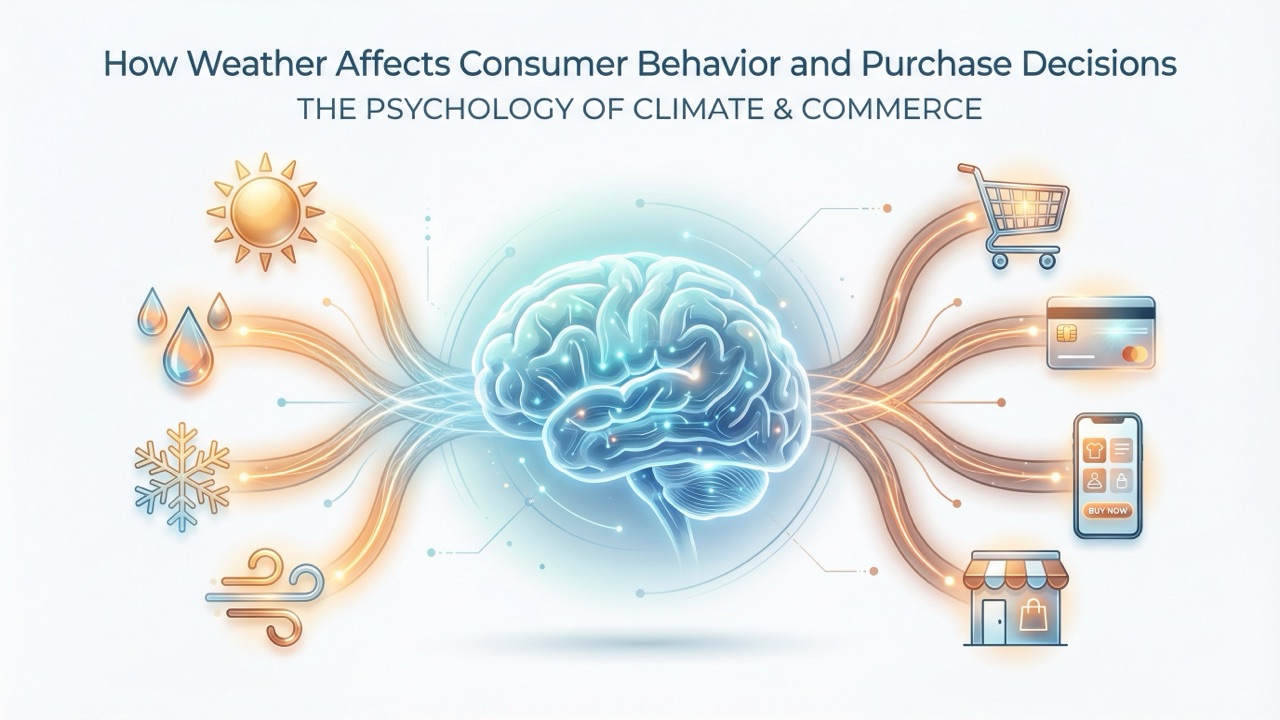
How does weather affect consumer behaviour? Mostly through timing and channel. Rain pushes spending online, heat moves it into the evening, cold and snow change big purchases, and the weather changes how people respond to ads.
The evidence for these effects is solid. But many of the statistics that circulate about weather and shopping, including some we used to publish on this page, can’t be traced to any study.
This page sets out what the research actually shows. Every figure below links to its source. Where the evidence is thin, we say so.
Updated September 2026. We rebuilt this page from primary sources and merged in our older post on weather events and buying behaviour.
The short version
- Rain moves spending online, but by single digits. US online spend rises up to 4.4% on the wettest days, and roughly twice that at weekends.
- Heat moves spending in time. On 35°C days in Australian cities, daytime card spending falls about 12% and evening spending rises about 5%.
- Weather changes ad response. Mobile promotions performed better in sunshine, and banner click-through rose in rain and cold.
- Much of the effect is timing. Weather often pulls demand forward or pushes it back rather than creating new demand. That’s why the moment you show an ad matters.
- The effects are local. The same weekend can lift a product in one city and sink it in another.
Key findings at a glance
| Finding | Source | Strength |
|---|---|---|
| Rain lifts US online spending by up to 4.4% (at 20–25 mm), with double the effect at weekends. Weather drove an estimated US$13.5B of US e-commerce in 2023 | Adobe × The Weather Company, 2023 | Large dataset, modelled |
| Mobile promotions got a 1.2x higher and 73% faster response on sunny days than cloudy days (6M+ users) | Li et al., Marketing Science, 2017 | Peer-reviewed field experiment |
| Banner click-through was 40% higher in rain and 34% higher in cold than in good weather | Weißmüller et al., Applied Marketing Analytics, 2017 | Peer-reviewed, single site |
| On days of 35°C or more in Sydney, Melbourne and Adelaide, daytime spending fell 12–13% and evening spending rose about 5% | Seijas et al., npj Urban Sustainability, 2025 | Peer-reviewed, ~200M transactions |
| A rainy day makes Facebook posts about 1.2% less positive and 1.2% more negative, and the mood spreads to friends | Coviello et al., PLOS ONE, 2014 | Peer-reviewed, Facebook co-authors |
| A week 11°C (20°F) warmer than normal raised the share of convertibles sold by 8.5% | Busse et al., Quarterly Journal of Economics, 2015 | Peer-reviewed, 40M+ car sales |
| Adding weather to an online fashion retailer’s forecasts cut forecast errors by up to 50% on extreme days | Steinker et al., Production and Operations Management, 2017 | Peer-reviewed |
| Weather explains about 3.4% of year-to-year variation in US economic output (about US$485B) | Lazo et al., Bulletin of the AMS, 2011 | Peer-reviewed |
Rain: a modest, reliable shift online
The best dataset on rain and online shopping comes from Adobe and The Weather Company. They analysed more than a trillion visits to US retail sites in 2023. They found:
- The rain effect peaks at around 20–25 mm in a day, lifting online spend by up to 4.4%. Heavier rain than that reduces the effect.
- The effect is about twice as strong at weekends. In autumn, even drizzle lifted e-commerce by about 5%.
- Moderate wind (roughly 24–32 km/h) also lifts online spending, but strong wind above about 48 km/h reduces it.
The UK version of the same analysis found wet weekends lifted online spend by 12%, against 1–4% on wet weekdays. UK footfall data points the same way: in February 2026, one of the wettest on record, UK footfall fell 4.7% year on year.
One important caveat. A Federal Reserve Bank of San Francisco study of a US apparel retailer found that online sales did not make up for the store sales it lost in bad weather. Rain moves some spending online, but for a retailer with shops, it isn’t a simple swap.
For advertisers: rainy weekends are the clearest moment to push e-commerce ads. Expect a lift of a few percent in demand, not a multiple.
Heat: spending moves to the evening and the following days
The strongest Australian evidence comes from Westpac card data. Researchers analysed about 200 million transactions in Sydney, Melbourne and Adelaide in 2023–24. On days of 35°C or more:
- Spending fell 12.1% between noon and 3 pm, and 13.3% between 3 pm and 6 pm
- Evening spending (6–11 pm) rose about 5%, with bars and clubs up 10–20%
- Spending over the following week was 2.4% higher
Other studies show the same pattern of heat changing where people buy:
- Food delivery: across 100 Chinese cities, lunchtime delivery orders rose more than 12.6% at 35°C and 21.4% at 40°C, compared with 20°C.
- Retail overall: the ABS attributed a 0.7% rise in Australian retail turnover in August 2024 to the warmest August on record.
- UK heatwave, June 2026: online non-food sales rose 5.1% year on year while in-store non-food sales fell.
- Drinks: in a 37.7°C week in June 2026, UK beer and cider sales rose 23.1% year on year and soft drinks 25.3%.
People adapt to rain, snow and cold over time, but the San Francisco Fed study found they don’t adapt to extreme heat. As heat days become more common, this effect is likely to matter more, not less.
For advertisers: on heat days, the demand for many products shifts to the evening and the days after. Delivery, drinks and cooling products rise during the heat itself.
Cold and snow: big purchases and bad decisions
Cold weather changes big-ticket choices as well as everyday ones:
- Cars: in a study of more than 40 million US car sales, 25 cm or more of snow raised the share of four-wheel-drive vehicles sold by about 6% over the following two to three weeks.
- Regret: cold weather at the time of ordering makes people overbuy winter gear. In US catalogue orders, a 17°C (30°F) drop in temperature on the order date made a return 3.95% more likely.
- Snow and online shopping: Adobe found that 15–20 cm of snow lifted online spend by about 4% in cities used to snow. In cities that rarely see snow, 25 cm cut spending by almost 30%.
For advertisers: a cold snap or snow forecast is a trigger for winter gear, heating, tyres and 4WDs. Expect more returns on cold-weather impulse buys.
Mood: weather changes the mindset of people seeing your ads
Weather’s effect on mood is well documented, and it reaches social feeds:
- Facebook: in a study co-authored by Facebook’s data scientists, a rainy day made posts about 1.2% less positive, and the effect spread to friends in other cities.
- Sentiment across 3.5 billion posts: positive sentiment peaked around 20°C and dropped above 30°C, in rain, and when humidity was above 80%.
- Spending: sunlight raises spending by reducing negative mood, according to a widely cited 2010 study.
- Indulgence: UNSW research found bad weather increases the appeal of indulgent products like chocolate.
- Valuation: sunshine and snow make people value products linked to that weather more, because they picture themselves using them. Rain doesn’t have the same effect.
This matters for ad response, not just shopping. In the Marketing Science field experiment with more than 6 million mobile users, promotions got a 1.2 times higher and 73% faster response on sunny days than on cloudy days, and a weaker, slower response on rainy days. Copy framed around avoiding a problem worked better in rain, and simple, neutral copy worked better in sunshine.
For advertisers: match the creative to the weather. Show the product being used in the conditions people can see out the window.
Much of the weather effect is timing
A Swiss study of national retail data found that unusual weather mostly shifts spending in time. A warm early spring pulls summer purchases forward, for example. The Westpac heat data shows the same thing within a day, with spending moving from the afternoon to the evening.
Weather effects are also very local. Planalytics’ 2025 figures show air-conditioner demand driven by weather up 13% in Kansas City and down 17% in New York over the same period.
Together, these findings are the strongest argument for weather-triggered ads. You’re unlikely to create much new demand, but you can make sure your ads are running in the right place at the moment demand arrives, and not running when it isn’t there.
What the research doesn’t show
- There’s no published study of weather’s effect on Google Search click-through or cost per click, or on Meta ad prices. The closest evidence is the mobile promotion, banner and Facebook mood studies above.
- Only two published case studies compare weather-triggered ads with a control on Meta or Google. Molson Coors found weather-specific Facebook ads cut cost per click by 67% compared with generic creative (2013, agency-reported). wetter.com reported better app retention from weather-scripted Google app campaigns at no higher cost per install (vendor-reported).
- Well-known campaigns like Pantene’s “Haircast” and Guinness’s Australian “Brewery of Meteorology” are real, but they ran on weather apps and digital billboards, not on Meta or Google.
If you run weather-triggered ads, the most reliable evidence will be your own. Keep a control region or period where the rule doesn’t run and compare results.
Statistics we’d stop using
These figures appear on many marketing blogs (including, until recently, this one). None of them holds up.
| Claim | Problem |
|---|---|
| “Weather influences 62% of purchasing decisions” | We found no original source. Search engines now cite pages like our old one as the source, which makes it circular. |
| “Weather affects one-third of the US economy / US$3 trillion” | A 2002 estimate (Dutton, Bulletin of the AMS) of how much industry has some exposure to weather risk, not how much weather moves sales. A later study put real sensitivity at about a tenth of that. |
| “Weather is the biggest influence on shoppers after the economy” (British Retail Consortium) | Quoted everywhere, but we couldn’t find the original BRC source. |
| “Weather affects 70% of businesses” | Comes from weather-derivatives marketing in the late 1990s, not a measurement. |
| “Weather targeting drives US$13.5B of e-commerce” | A misquote. Adobe estimated spending caused by weather, not by weather targeting. |
What it means for your ads
- Pick the weather that moves your product. Rain for delivery and indoor products, heat for drinks and cooling, cold snaps for heating and winter gear, storms for roofing and repairs.
- Set rules by location. Weather effects are local, so a national on/off switch will miss most of them.
- Think about timing. For heat, that can mean the evening and the days after. For rain, it means weekends.
- Match the creative. Ads that reflect the weather people are experiencing perform better.
- Measure against a control. Hold back one region or period so you can see the real lift.
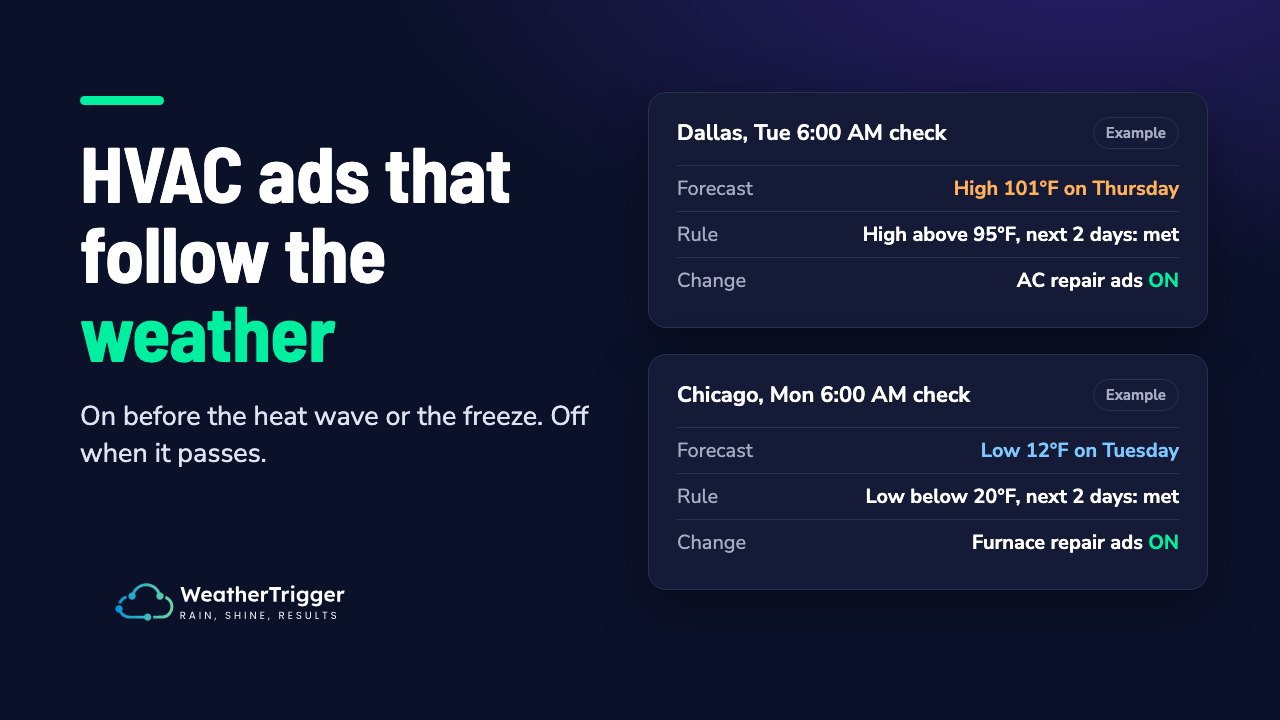
WeatherTrigger automates the on/off part for Meta ads. It checks the forecast for each location on your chosen schedule and pauses or resumes ad sets when your conditions are met, with a log of every check. Every plan starts with a 30-day free trial, no card needed.